
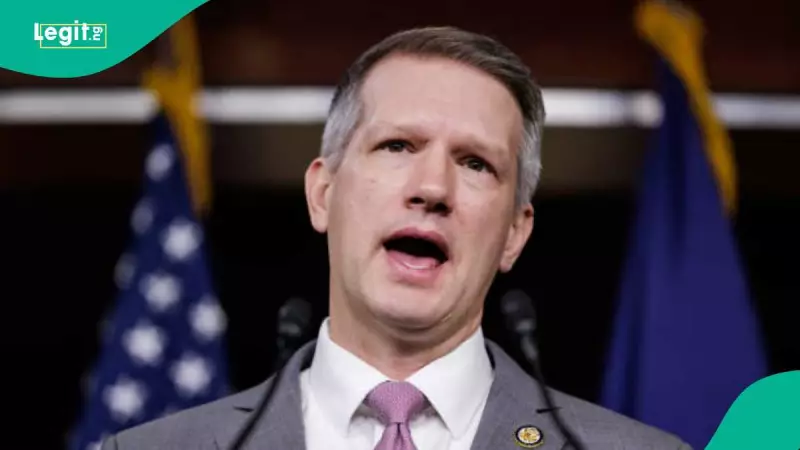
In a significant development drawing international attention to Nigeria's security situation, United States Congressman Riley Moore has announced a formal congressional investigation into the alleged persecution of Christians in Nigeria. The probe was initiated at the direction of US President Donald Trump.
Trump Directs Congressional Investigation
Congressman Moore, a member of the House Appropriations Committee, made the announcement via his official X (formerly Twitter) account on December 2, 2025. He stated that President Trump had personally asked him and the House Appropriations Committee GOP members to investigate the issue.
"President Trump asked me and @HouseAppropsGOP to investigate the persecution of Christians in Nigeria," Moore wrote. He emphasized the committee's commitment, adding, "We will never turn a blind eye to our brothers and sisters in Christ who suffer for their faith."
Roundtable to Gather Critical Testimony
As a central part of this investigation, the committee is organizing a congressional roundtable. The primary objective of this gathering is to collect firsthand testimony and evidence that will inform a comprehensive report on the situation.
According to Moore, this report, mandated by President Trump, will scrutinize the reported massacres targeting Nigerian Christians. Furthermore, it aims to outline concrete steps the US Congress can take to bolster the White House's global efforts to protect vulnerable religious communities.
This move places a renewed and powerful spotlight on the plight of Christian communities in Nigeria, where attacks by armed groups have been a persistent source of domestic tragedy and international concern.
Background of Allegations and Diplomatic Tensions
The congressional action follows a series of strong allegations from President Trump, which have stirred diplomatic reactions. In late October and November 2025, Trump designated Nigeria as a "Country of Particular Concern," claiming that thousands of Christians had been killed by radical elements.
His statements, which included warnings of potential US military intervention if the Nigerian government failed to act, were met with sharp rebuttals from Nigerian officials.
This issue was also a topic of high-level discussions between US and Nigerian officials. In November 2025, Congressman Moore met with Nigeria's National Security Adviser, Nuhu Ribadu, in Washington D.C. Their talks focused on the alleged persecution and broader terrorist threats, exploring avenues for enhanced US-Nigeria cooperation to end the violence.
During that meeting, Moore was unequivocal, stating he made it "crystal clear that the United States must see tangible steps to ensure that Christians are not subject to violence, persecution, displacement, and death simply for believing."
The upcoming roundtable marks a pivotal step in formalizing US congressional engagement with Nigeria's religious freedom and security challenges. The findings are expected to provide evidence that could shape future American foreign policy and aid decisions related to Nigeria.




