
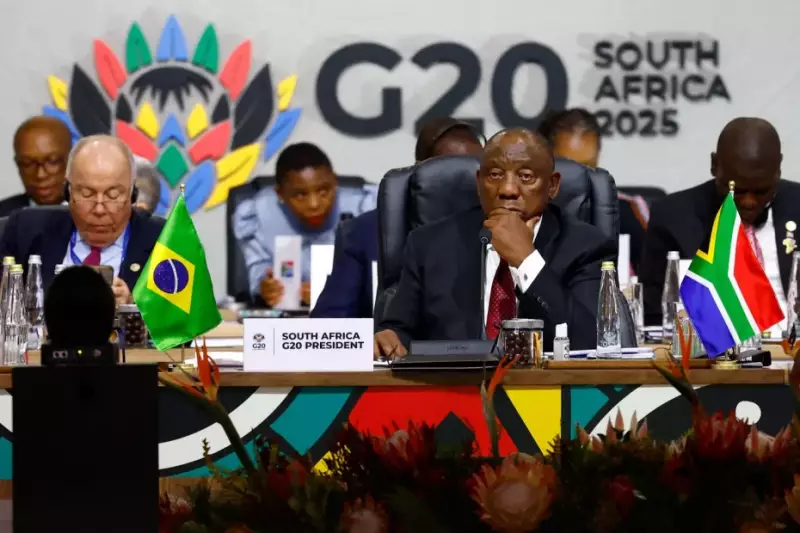
In a significant diplomatic shift, the United States has decided to exclude South Africa from the guest list for next year's G20 summit, extending an invitation instead to Poland. The move signals a major realignment within the influential economic forum and highlights rising tensions between Washington and Pretoria.
A New G20 Guest: Poland's Economic Rise Rewarded
U.S. Secretary of State Marco Rubio confirmed the decision on December 5, 2025, in a statement titled "America Welcomes a New G20." He positioned Poland, whose economy recently crossed the $1 trillion threshold, as a model of post-Communist transformation. "Poland, a nation that was once trapped behind the Iron Curtain but now ranks among the world's 20 largest economies, will be joining us to assume its rightful place in the G20," Rubio wrote.
The invitation underscores a clear U.S. intent to reward nations it views as success stories. Poland's economic output now surpasses that of Switzerland and nears the levels of Saudi Arabia and the Netherlands. Rubio directly linked Poland's growth to its partnership with America, stating its success proves "a focus on the future is a better path than one on grievances."
Contrasting Trajectories: U.S. Criticism of South Africa
The announcement served as a direct critique of South Africa, a full G20 member. Secretary Rubio drew a sharp contrast between the two nations, criticizing what he termed South Africa's "burdensome regulatory and redistributionist policies." He accused Pretoria of undermining U.S. contributions during its year leading the G20, actions he said had "tarnished the forum's credibility."
Rubio was blunt in his assessment, stating, "The South African economy has stagnated under its burdensome regulatory regime driven by racial grievance and corruption." He further alleged that South African officials had routinely ignored U.S. objections to consensus documents and blocked input from the U.S. and other countries during negotiations.
South Africa's Response and the Road Ahead
In response, South Africa indicated it would not fight the exclusion. Presidential spokesman Vincent Magwenya stated the country was prepared to sit out the 2026 series of meetings, which will be held in Miami. The nation plans to resume its participation when the G20 presidency rotates to Britain the following year.
"For now, we will take a commercial break until we resume normal programming," Magwenya said on social media. This development follows a Washington boycott of the G20 summit hosted in Johannesburg, with tensions further inflamed by unverified claims from former U.S. President Donald Trump regarding South Africa's internal affairs.
The exclusion of South Africa marks a dramatic moment for the G20, an institution designed for economic cooperation. It highlights how geopolitical fissures and differing views on economic governance are reshaping international alliances and forums. All eyes will now be on the 2026 Miami summit to see how this altered dynamic plays out on the global stage.




