
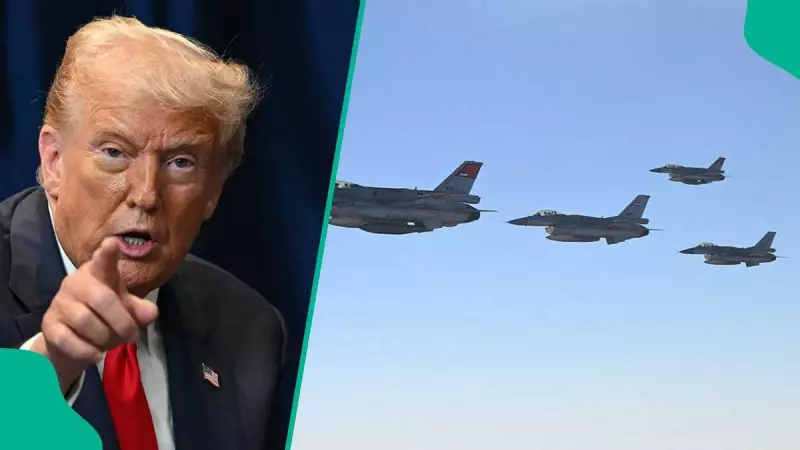
The United States military has confirmed conducting a lethal strike against a vessel operated by a designated terrorist organization in the Caribbean on Thursday, November 7, 2025, resulting in three fatalities.
Operation Details and Official Statements
Secretary of Defence Pete Hegseth announced that the operation was authorized by President Donald Trump and executed by the Department of War. In a statement posted on X (formerly Twitter), Hegseth declared: "Today, at the direction of President Trump, the Department of War carried out a lethal kinetic strike on a vessel operated by a Designated Terrorist Organisation."
The defence secretary further clarified that the vessel was trafficking narcotics in international waters of the Caribbean and confirmed that no American forces suffered any harm during the military operation.
Broader Campaign Against Drug Networks
According to official statements, Thursday's strike forms part of a comprehensive campaign launched by Washington to disrupt the flow of illegal narcotics into the United States. This ongoing initiative has produced significant results since its inception.
The campaign has so far conducted 17 separate strikes, destroying 18 boats and eliminating 70 individuals involved in drug trafficking operations. Among the casualties, only three people have survived the various operations. Two survivors were briefly detained by the US Navy before being repatriated, while one individual remains missing and is presumed dead.
A senior Pentagon official characterized the operation as implementing a "decisive strategy to dismantle terror-linked drug networks" that threaten regional security and American interests.
Legal Controversy and Human Rights Concerns
The Trump administration's approach has generated significant controversy within Congress and among human rights organizations. Critics have raised serious questions about the administration's classification of drug traffickers as "unlawful combatants" and the legal justification for conducting lethal strikes without judicial oversight.
Human rights advocates have strongly argued that suspected traffickers should face proper judicial prosecution rather than extrajudicial killings. However, the Justice Department's Office of Legal Counsel has reportedly issued a classified opinion supporting the administration's authority to conduct such operations under wartime provisions.
The ongoing debate highlights the tension between national security concerns and international human rights standards, particularly regarding the treatment of individuals engaged in criminal activities with alleged terrorist connections.
Venezuela Connection and Future Implications
The Trump administration has simultaneously been attempting to establish connections between Venezuelan President Nicolás Maduro and international drug trafficking networks, even as it increases military presence near Caracas.
Despite these developments, during a closed-door congressional briefing, Secretary of State Marco Rubio, Defence Secretary Hegseth, and White House legal officials assured lawmakers that the United States currently has no plans to conduct strikes inside Venezuelan territory.
One official explicitly clarified that "the legal justification for these maritime strikes does not extend to land-based targets." However, officials did not completely rule out future actions, with one source stating that "all options remain on the table should threats escalate."
The situation continues to develop as the US maintains its aggressive stance against terrorist-linked drug trafficking operations in the Caribbean region.




