
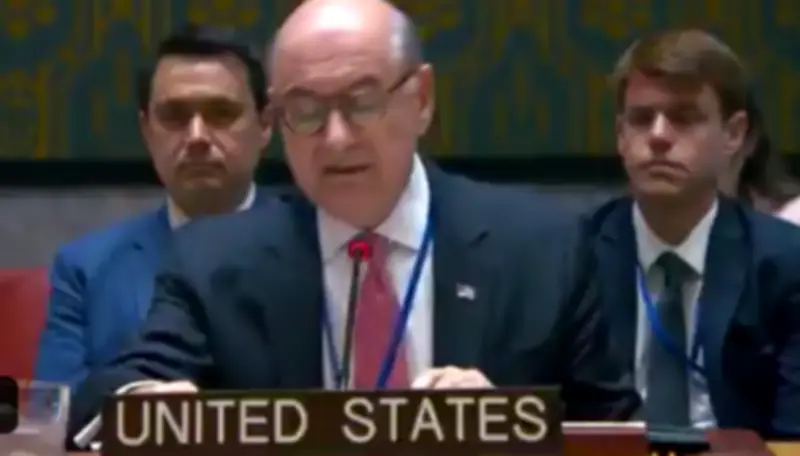
The United States delegation walked out of a United Nations Security Council meeting on Monday, July 27, 2026, as France's ambassador began to speak, protesting French comments that compared Washington to North Korea and other authoritarian states. The rare diplomatic confrontation occurred during a session focused on the war in Ukraine, but quickly escalated into a public dispute over human rights records and voting patterns at the UN.
Dan Negrea, an alternate representative to the UN General Assembly and a senior US delegation official, condemned what he called “disingenuous grandstanding” by Paris. He explained the walkout, stating: “There is a member of this council that will feign moral outrage and pretend to lecture the rest of us about every topic, whether it’s about the very conflict we’re discussing yet again today, or even those unrelated to international peace and security, like human rights. That is why we walked out during France’s intervention.” Such a walkout from the Security Council—the UN’s highest decision-making body, where both France and the United States are veto-wielding permanent members—is extremely unusual.
Context of the Dispute: The Human Rights Vote
The tension originated on Friday, July 24, when the UN General Assembly voted on extending Volker Turk’s term as UN High Commissioner for Human Rights. The United States was one of only 10 countries to vote against the extension, placing it alongside North Korea, Russia, Nicaragua, Mali, and other states that opposed the reappointment. France, which supported Turk’s extension, quickly criticized the US stance. France’s mission to the United Nations in Geneva posted on social media after the vote: “The US used to be a beacon of human rights. Not anymore. Today, it stands alongside North Korea, Nicaragua, Mali & Russia, isolated. And the world no longer listens to it.” This statement directly sparked the US walkout at the Security Council.
The General Assembly vote saw 162 countries in favor of extending Turk’s term, with only 10 against and 15 abstentions, according to UN records. The US decision to join Russia and North Korea in opposition marked a significant shift from its traditional leadership role in human rights advocacy.
French Ambassador's Response and US Remarks
French Ambassador Jerome Bonnafont, after the US walkout, responded by referencing historical ties between the two nations. He said: “This year we are celebrating the 250th anniversary of the United States. And everyone knows the role France has played in that.” He added that France continues to work at the UN, both in the Security Council and the General Assembly, “to preserve this institution, its independence, and its capacity to act in service of the charter, in service of human rights, and in service of peace.” The remark highlighted the irony of the walkout occurring in the year of US bicentennial celebrations, as France was a key ally during the American Revolution.
In his earlier remarks, Negrea defended the US human rights record, stating: “I remind them that it is the United States that remains the beacon of liberty for the world. As such, we will not be affording them the benefit of listening to their politicized drivel.” He did not specify which human rights concerns prompted the US vote against Turk, but the walkout underscored the deepening rift between Washington and its traditional European allies on multilateral issues.
A Rare Diplomatic Clash Between Allies
The confrontation between the US and France is among the most public and sharp exchanges between the two NATO allies in recent years. While they have disagreed on trade, climate policy, and military strategy, walking out of a Security Council meeting is a dramatic step. The video of the walkout circulated widely on social media, with Al Jazeera English tweeting: “A rare diplomatic clash between the US and France has erupted at the UN Security Council. Washington walked out during a French speech after a dispute over the re-election of the UN human rights chief, sparking a public war of words between the allies.” The incident highlights the broader erosion of consensus within the UN as major powers increasingly use multilateral forums to score political points.
Observers noted that the walkout could complicate future cooperation on Ukraine, Iran, and other crises that require Security Council unity. With both countries holding veto power, such public spats risk paralyzing the council. The US delegation declined further comment, and the French mission reiterated its commitment to human rights and the UN Charter. The long-term impact of this clash on US-France relations remains to be seen, but it signals a new chapter of tension between two founding members of the post-World War II order.




