
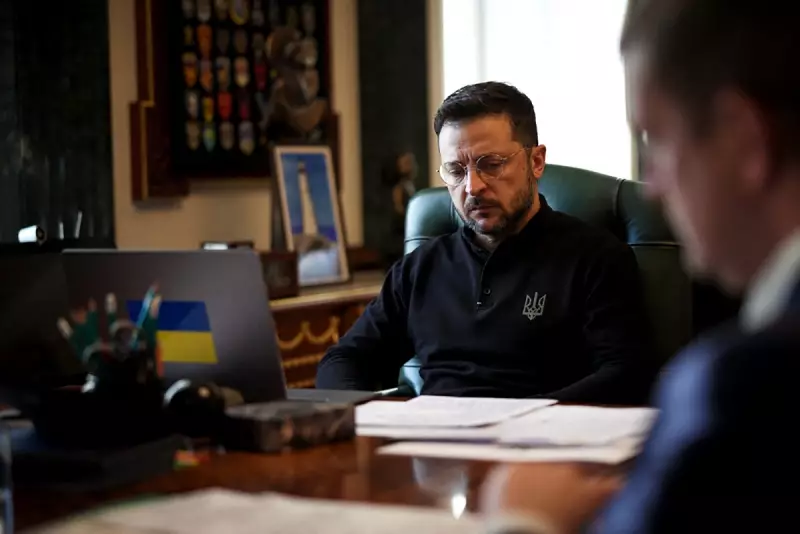
Ukrainian President Volodymyr Zelensky has publicly outlined a comprehensive new plan, developed with the United States, aimed at bringing a definitive end to the ongoing war with Russia. The details were presented to journalists, including AFP, during a briefing in Kyiv on December 24, 2025.
The Core of the US-Ukraine Proposal
President Zelensky revealed that negotiators from Kyiv and Washington have agreed on a detailed 20-point document, which has now been forwarded to Moscow for its response. This plan is set to be bolstered by additional bilateral pacts on security and post-war reconstruction between the two nations.
The cornerstone of the proposal is the reaffirmation of Ukraine's sovereignty and a formal non-aggression pact with Russia. A key element involves establishing a robust monitoring mechanism using space-based unmanned systems to oversee the line of contact and ensure early detection of any violations.
Security Guarantees and Military Provisions
The plan envisions powerful security guarantees for Ukraine from the United States, NATO, and European signatories, modeled on NATO's Article 5 collective defence principle. A critical condition is that Ukraine's Armed Forces will maintain a peacetime strength of 800,000 personnel.
The guarantees include a clear trigger: if Russia invades again, a coordinated military response would be initiated and all global sanctions against Moscow would be reinstated. Conversely, the guarantees would be voided if Ukraine were to launch an unprovoked attack on Russian territory.
Economic Reconstruction and European Integration
On the economic front, the proposal is ambitious. It promises Ukraine's membership in the European Union within a defined timeframe, coupled with immediate privileged access to the EU market. A massive global development package is also on the table.
This includes the creation of a Ukraine Development Fund targeting high-growth sectors like technology and AI, along with US cooperation in rebuilding the country's gas infrastructure. A capital and grants fund with a target size of $200 billion is proposed for transparent investment in Ukraine's recovery. The World Bank is expected to provide a special financing package to accelerate these efforts.
Key Territorial and Humanitarian Measures
The plan addresses the complex issue of territory by proposing that the line of troop deployment in the Donetsk, Luhansk, Zaporizhzhia, and Kherson regions at the time of the agreement be de facto recognized as the line of contact. A working group would determine force redeployments and parameters for potential future special economic zones.
For the agreement to take effect, Russia must withdraw its troops from the Dnipropetrovsk, Mykolaiv, Sumy, and Kharkiv regions. International forces would then be deployed to monitor compliance along the contact line.
Significant humanitarian provisions are included, such as an "all-for-all" prisoner of war exchange and the return of all detained civilians and hostages. The agreement also mandates that Ukraine hold elections as soon as possible after signing.
Notable Specific Clauses
Other critical points in the 20-point plan include:
- Ukraine reaffirming its status as a non-nuclear state.
- The Zaporizhzhia Nuclear Power Plant being jointly operated by Ukraine, the US, and Russia.
- Commitments to educational programs promoting tolerance and the implementation of EU rules on religious and linguistic minority protection.
- Russia agreeing not to obstruct Ukraine's commercial use of the Dnipro River and the Black Sea.
The proposed agreement is designed to be legally binding, with its implementation monitored by a Peace Council to be chaired by US President Donald Trump. This council would include representatives from Ukraine, Europe, NATO, Russia, and the United States, with sanctions applicable for any violations. A full ceasefire would take effect immediately upon acceptance by all parties.




