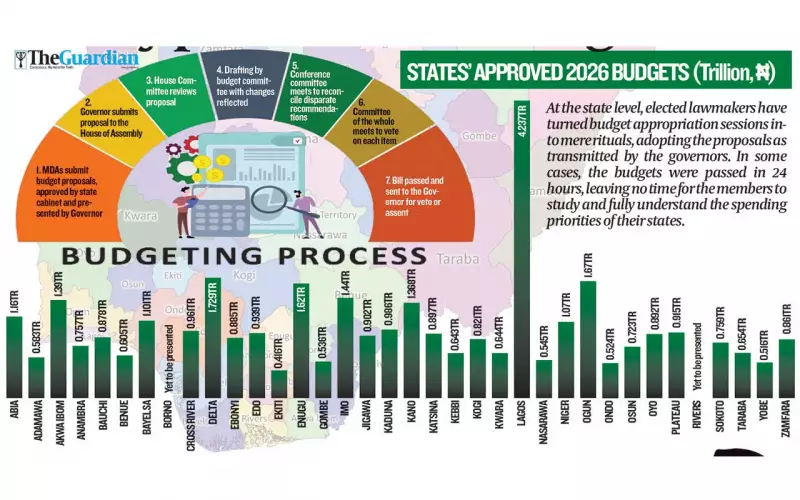
Across Nigeria, a troubling pattern has emerged in the passage of state budgets for the 2026 fiscal year. Legislative houses are rushing through appropriation bills, often returning them to governors with little to no changes, raising serious questions about the quality of oversight and the sanctity of the budgeting process.
A Nationwide Trend of Hasty Approvals
The collective spending plan for 34 states stands at a staggering N34.63 trillion for the coming year. This figure represents a significant 54.4% increase from the N22 trillion appropriated by the 36 states for 2025. On average, each state plans to spend about N1.02 trillion, a sharp rise from this year's N611 billion average.
However, the speed of approval has alarmed observers. In a striking example, Imo State lawmakers passed a N1.44 trillion budget presented by Governor Hope Uzodinma in less than 24 hours, without altering the figures. Similarly, the assemblies in Edo, Ekiti, and Enugu states returned the governors' appropriation bills exactly as received, without any amendments.
While some states like Rivers and Borno are yet to present their estimates, others have completed the entire cycle—presentation, passage, and assent—in a matter of weeks or even days. This brisk process has turned budget sessions into mere rituals, undermining the legislature's constitutional role as a check on executive power.
Echoes of a Flawed Federal Process
Analysts note that state legislators appear to have borrowed an "ugly leaf" from the National Assembly, where a culture of accelerated passage with minimal scrutiny has taken root. At the federal level, the foundational 2026-2028 Medium-Term Expenditure Framework (MTEF) was submitted months late, violating the Fiscal Responsibility Act which requires submission at least four months before the new fiscal year.
Despite this procedural breach, President Bola Tinubu presented the N58.18 trillion 2026 appropriation bill, and the National Assembly is processing it with similar haste. The Senate and House of Representatives passed the MTEF document within three days, retaining all key parameters despite expert cautions.
Senator Adeola Olamilekan, Chairman of the Senate Committee on Appropriations, acknowledged confusion around the budget figures, noting a discrepancy between the N58.18 trillion in the President's speech and the N58.247 trillion in legislative documents. He later declared the appropriation bill itself as the authoritative document, fixing the figure at N58.472 trillion.
Structural Defects and Eroding Accountability
Beneath the surface of these rapid approvals lie deeper structural problems. The delayed submission of budgets—often held back until the federal budget is passed—creates a time crunch that forces lawmakers to improvise and sacrifice thorough scrutiny. This practice reduces state budgets to little more than executive wish lists, often catering to populist agendas rather than addressing specific socio-economic needs.
Financial analyst Seun Onigbinde of BudgIT described Nigeria's budgeting system as "a system without a calendar," lamenting the collapse of predictable cycles. This unpredictability weakens planning, oversight, and ultimately, accountability.
The situation is compounded by consistently poor budget performance. In recent years, few states have achieved 80% budget implementation, with many struggling to cross 60%. Critical capital expenditures, which directly impact citizens' welfare, often perform below 50%.
Former Central Bank deputy director Bashorun Olorunfunmi emphasized that while the public sees only the final dates, the real issue lies in how lawmakers monitor budget implementation. He stressed that proper due diligence before submission can minimize delays and improve outcomes.
As Nigeria grapples with rising debt, stagnant revenues, and delayed project execution, the hurried passage of trillion-naira budgets without rigorous examination threatens to deepen public distrust and stall development. The erosion of strong legislative checks and balances poses a fundamental challenge to the country's democratic governance and fiscal health.