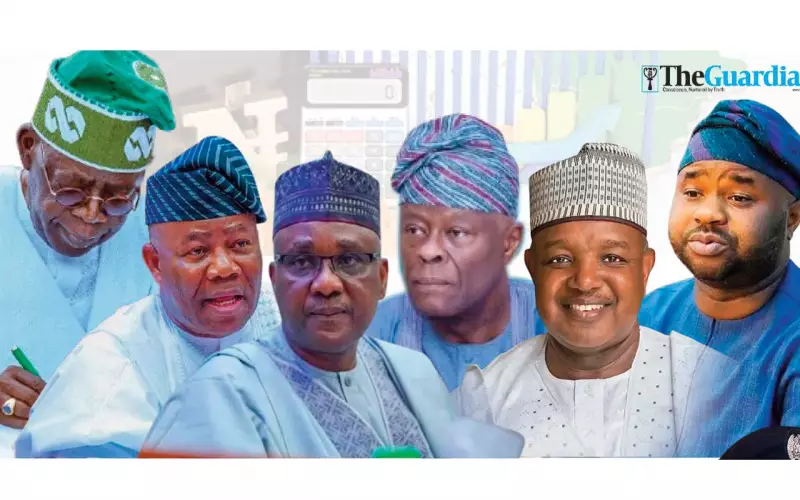
Nigeria's ambitious 2026 fiscal plan is facing a dual threat from legislative pushback on critical tax reforms and a severe revenue shortfall, raising fears that the budget may be derailed before it even begins.
Presidency Seeks Sweeping Fiscal Reset Amidst Budget Chaos
In a dramatic move to address the country's chaotic budgeting process, President Bola Ahmed Tinubu has asked the National Assembly to approve a N43.56 trillion spending plan that would consolidate the 2024 and 2025 appropriation acts. This request, sent via the Appropriation (Repeal and Re-enactment Bill-2), 2024–2025, aims to end the practice of running multiple budgets concurrently.
The President's letter argued the bill would ensure high capital performance rates for the 2024 and 2025 budgets while reinforcing fiscal discipline. However, this consolidation creates a complex scenario where a potential 2026 budget would have to compete for implementation with this massive two-year spending plan.
Legislative Gridlock Over Oil Benchmark and MTEF/FSP
The path to the 2026 budget is already rocky. While the Senate passed the 2026–2028 Medium-Term Expenditure Framework and Fiscal Strategy Paper (MTEF/FSP), the House of Representatives stepped it down on December 17. The disagreement centered on the proposed crude oil benchmark price.
The joint committee, chaired by James Faleke, suggested lowering the 2026 benchmark from $64.85 to $60 per barrel, citing market volatility. Speaker Tajudeen Abbas warned this reduction could seriously impact the proposed N54.46 trillion 2026 budget, questioning how resulting revenue gaps would be filled. The House has asked the committee to revise its figures.
This impasse is critical because, by law, budgets can only be prepared on a duly approved MTEF/FSP. Despite this, President Tinubu is scheduled to present the 2026 budget estimates to a joint session of the National Assembly on Friday, December 19.
Mounting Opposition to Tax Reforms
At the core of the government's strategy to boost revenue are new tax reforms. However, these measures are facing fierce resistance. A coalition named the National Opposition Movement (NOM) has demanded an immediate suspension of the reforms, warning they could worsen poverty and cause social dislocation.
The group accused the government of trying to fix its own failures through punitive taxation of ordinary Nigerians. They called for broader consultations and a shift of the tax burden away from low-income earners, vowing to resist any policy that "punishes the poor to excuse leadership failure."
This opposition persists despite the government's clarification that the new scheme is progressive. It exempts individuals earning N800,000 and below from Personal Income Tax (PIT) and also provides exemptions for small businesses.
Acute Revenue Shortfall Exposes Fiscal Vulnerability
The urgency for tax reform is underscored by a staggering revenue crisis. Finance Minister Wale Edun disclosed to House committees that the Federal Government will likely record a N30.1 trillion revenue shortfall for 2025. From a projected N40.8 trillion, actual revenue is expected to be only about N10.7 trillion.
Edun blamed weak oil and gas revenues, particularly from Petroleum Profit Tax (PPT) and Company Income Tax (CIT). This translates to a mere 26% revenue performance, potentially making 2025 the poorest year for federal revenue collection in recent history.
Economists Warn of Deepening Uncertainty
Financial experts have expressed grave concerns about the emerging fiscal framework. Dr Muda Yusuf of the Centre for the Promotion of Private Enterprise noted that while an Appropriation Act is law, its success depends on realistic assumptions. "A law that is fiscally unrealistic will inevitably fail in implementation," he stated.
Former central banker Dr Bature Yunana warned that implementing agencies could face operational challenges due to the complex, overlapping budget structure. The practice of running multiple budgets—such as in 2024 when Nigeria operated three simultaneously—complicates monitoring, evaluation, and effective implementation of development projects.
As the National Assembly races against time to reconcile the MTEF/FSP and consider the President's consolidation bill, Nigeria's fiscal stability for 2026 hangs in a delicate balance, threatened by internal disagreements and a stark revenue reality.