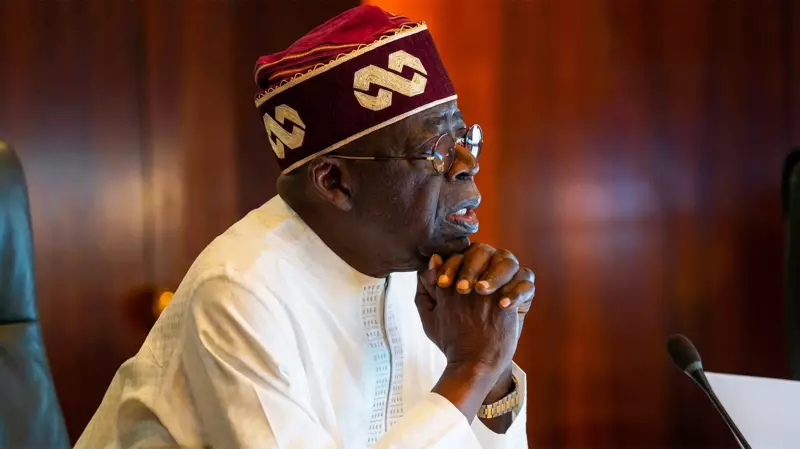
President Bola Ahmed Tinubu has taken a decisive step to streamline Nigeria's fiscal planning by formally requesting the National Assembly's approval for a consolidated N43.56 trillion spending plan. The move is designed to terminate the longstanding and problematic practice of running multiple national budgets simultaneously.
A Unified Spending Blueprint
On Wednesday, December 17, 2025, President Tinubu transmitted the Appropriation (Repeal and Re-enactment) Bill-2, 2024-2025 to the House of Representatives. The bill seeks legislative authorization to issue N43,561,041,744,507 from the Consolidated Revenue Fund for the period ending December 31, 2025.
Deputy Speaker Benjamin Kalu read the President's letter during plenary, detailing the proposed allocation. The breakdown includes N1.74 trillion for statutory transfers, N8.27 trillion for debt servicing, N8.11 trillion for recurrent (non-debt) expenditure, and a significant N22.28 trillion earmarked for capital expenditure and development fund contributions.
Addressing a Legacy of Fiscal Overlap
This legislative action directly confronts a chronic issue where the Federal Government, often with National Assembly support, extends the capital components of old budgets, leading to several budgets running concurrently. This has historically complicated planning and delayed project completion.
For instance, in 2024, Nigeria operated three different budgets: the N21.8 trillion 2023 budget, the N2.17 trillion 2023 supplementary budget, and the N28.7 trillion 2024 appropriation. Although the first two were passed under former President Muhammadu Buhari, President Tinubu extended their capital components first to June and then to December 2024.
The trend persisted into 2025, with the capital component of the 2024 budget extended twice, first to June and then to December 2025. Consequently, the nation is currently implementing two budgets: the extended 2024 budget and the 2025 budget of approximately N54.2 trillion.
Key Provisions for Transparency and Discipline
In his letter, President Tinubu emphasized that the new bill is engineered to ensure unprecedentedly high performance rates for the 2024 and 2025 capital budgets, marking a shift toward more capital-intensive spending. The proposed law establishes a transparent framework for appropriating critical, time-sensitive expenditures related to national security and public welfare emergencies.
The bill introduces stricter accountability measures, mandating that appropriated funds be released and used strictly for their designated purposes. It stipulates that any alteration to approved expenditures (virement) requires prior National Assembly approval. Furthermore, the legislation sets conditions for correcting genuine errors, mandates separate recording of excess revenue, and requires periodic reporting on fund releases and agency revenues.
President Tinubu has urged the House of Representatives to consider and pass this bill expeditiously, signaling a strong commitment to fiscal clarity and disciplined implementation.