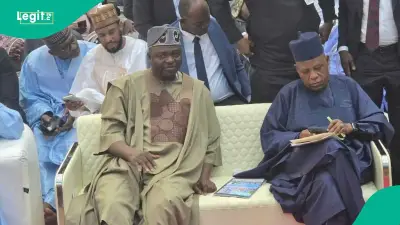
The Benue State Governor's office has pushed back against an alleged presidential directive that would grant automatic re-election tickets to all sitting APC office holders in the state, warning that the policy could backfire severely on the party. Chief Press Secretary to Governor Hyacinth Alia, Sir Tersoo Kula, raised the alarm while fielding questions from journalists in Makurdi. He said that if President Bola Tinubu did indeed issue such a directive, it was likely based on incomplete or inaccurate information about how politics works in Benue. Legit.ng could not independently verify the existence of the directive.
Alleged Automatic Ticket Policy Under Fire
Kula described the alleged policy as "self-defeating," arguing that overriding existing zoning arrangements would stir resentment among voters and hand the opposition an easy target. The warning comes as political tensions rise in the state ahead of the 2027 general elections, with the governor's office seeking to protect the party's electoral prospects.
The aide challenged the directive's premise, noting that it fails to account for the unique political dynamics in Benue, where voters have historically rejected prolonged tenure in office. This stance aligns with the state's deep-rooted commitment to rotational leadership, a principle that has shaped political office sharing for generations.
Benue's Rotational Leadership Culture
At the heart of the dispute is a Tiv political principle known as "ya na angbian," loosely translated as "eat and pass to your brother." Kula said this tradition of rotational leadership has shaped how political offices are shared across Benue for generations, and he traced part of its introduction into wider national political thinking to the late Joseph Sarwuan Tarka.
He noted that Benue voters have historically resisted politicians who hold on to elective offices for extended periods, pointing to former Senate President David Mark and former Benue Governor Sen. George Akume as rare examples of politicians who won repeated mandates in the state.
"Our people detest sitting tight in leadership. They prefer to rotate," Kula said, cautioning that disregarding this sentiment could trigger protests or deliberate protest votes against the APC. This cultural preference underscores the potential backlash the party could face if the alleged directive is implemented without regard for local traditions.
Allegations of Deliberate Mischief
Beyond the policy itself, Kula raised suspicions about who may have pushed for the directive and why. He suggested that certain political actors could be working to weaken the APC in Benue, intending to later shift the blame onto Governor Alia. Others, he alleged, may be trying to protect their own influence by stopping the governor from consolidating authority within the party.
"Whoever gave that advice knew he was planting landmines for Governor Alia and the APC in Benue State. That was pitching the Governor against the people," he said. He added that automatically clearing all incumbents for re-election, without regard for tenure history or existing zoning agreements, risked creating internal party fractures that could prove difficult to repair before the 2027 general elections.
The governor's office has urged party leaders to reconsider the alleged directive, emphasizing the need to respect local political traditions and maintain unity within the APC. The warning highlights the delicate balance between national party directives and state-level political realities, as Benue prepares for the upcoming electoral cycle.