
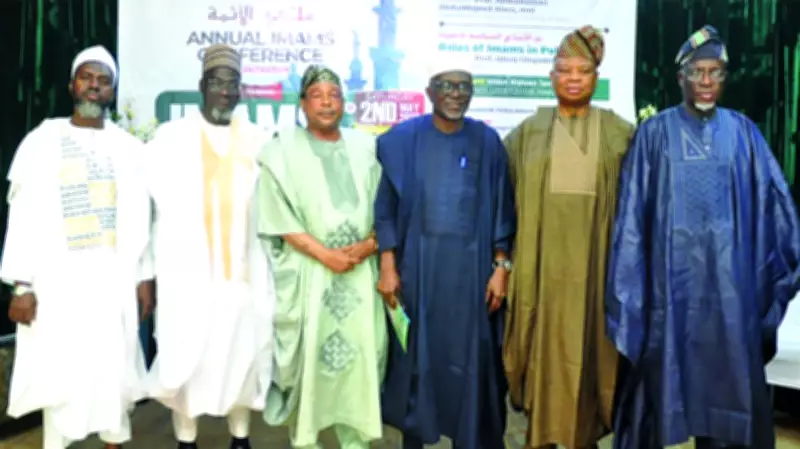
In a move to insulate the sanctity of the pulpit from the fray of partisan politics, the Registrar of the Joint Admissions and Matriculation Board (JAMB) and Secretary General of the Nigerian Supreme Council for Islamic Affairs (NSCIA), Prof. Ishaq Oloyede, has called on Islamic clerics to resign their positions before contesting for elective offices.
Speaking last Saturday at the 2026 Annual Imams Conference organized by the Lekki Muslim Ummah (LEMU), Oloyede warned that the dual role of a religious leader and a political candidate risks polarizing the mosque and undermining the spiritual cohesion of the community. The event, themed “Imams, Politics & Leadership,” was held at the Vice Admiral Jubril Ayinla Multipurpose Hall, Lekki Central Mosque, drawing over 400 clerics and scholars to deliberate on the evolving role of the faith in governance.
Oloyede: Pulpit Not a Campaign Platform
Addressing the gathering on ‘The Roles of Imams in Politics’, Prof. Oloyede argued that while Imams must remain socially conscious, the Minbar (pulpit) must never be converted into a campaign rostrum. “If an Imam is interested in any elective position, that Imam should resign and contest. All those who are your political opponents are not necessarily opponents of the mosque. If you stand as Imam and candidate, you are likely to confuse the two.
“The Imam should not polarize the mosque by being both the Imam and a candidate in the community,” Oloyede stated. The erudite scholar emphasized that rather than being outwardly partisan, Imams should educate their congregations on the art of political negotiation, focusing on securing community interests and minimum requirements for support rather than the monetization of votes.
Alaro: Voting as a Tool for Communal Survival
Providing a scholarly perspective on the jurisprudence of civic participation, Prof. AbdulRazzaq AbdulMajeed Alaro, a Professor of Law at the University of Ilorin, offered a nuanced take on the Shariah Position on Voting. Alaro posited that while the core tenets of democracy, where human will can override divine decree are un-Islamic, the act of voting is a necessary tool for communal survival in a pluralistic society. Alaro noted that democracy often allows choices irrespective of Sharia dictates. He argued that the danger of political isolation constitutes an existential threat to Muslims.
“Without existence, you cannot practice your religion. The danger of isolation is far greater than what we want to avoid by not participating,” he noted.
Chief Imam Jamiu: Islam Beyond the Mosque
The Chief Imam of Lekki Central Mosque, Sheikh Dr. Ridwanullah Jamiu, reinforced the idea that Islam cannot be confined to the masjid. He described the religion as a comprehensive guide for family, business, and social relations. “If you fail to participate because politics is dirty, you leave it to the dirty people, and they will mess up everything,” Dr. Jamiu warned. He noted that because Imams are the closest leaders to the people, they must be equipped with the right guidance to steer their congregations through the electoral process.
LEMU President: Conference Beyond Election Cycles
Earlier, the President of LEMU, Dr. AbdulGaniy Labinjo, explained that the conference’s objective extends beyond election cycles. He noted that for over seven years, the forum has provided a platform for Imams to align Quranic principles with contemporary national issues. “Today, we have more than 400 Imams in attendance, along with eminent scholars,” Labinjo said, highlighting the increasing participation as a sign of the conference’s relevance in shaping ethical leadership within the Ummah.




