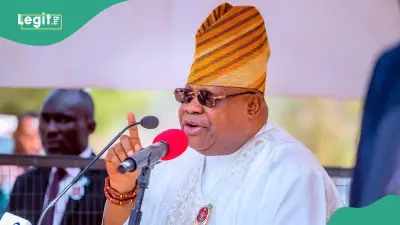
Osun State Governor Ademola Adeleke has filed a ₦2 billion lawsuit against the Economic and Financial Crimes Commission (EFCC) over the freezing of the state's Federal Statutory Allocation Account. The originating summons, filed before the Federal High Court in Abuja, seeks exemplary and aggravated damages for what the governor describes as unlawful interference with public funds.
Legal Action and Parties Involved
The legal team, led by M. T. Adekilekun, SAN, filed the suit on behalf of Adeleke, with the Attorney General of Osun State and the state's Accountant General listed as second and third plaintiffs. The EFCC, its chairman, and First Bank Nigeria Limited are named as defendants. The plaintiffs are asking the court to determine several legal questions regarding the account freeze and to order the defendants to cover litigation costs.
No hearing date has been fixed as of the time of filing, but the legal move adds a new dimension to the ongoing standoff between the state government and the anti-graft agency.
EFCC's Justification for the Freeze
The EFCC confirmed on Wednesday that it froze the account to prevent the movement of public funds under investigation. The agency has been probing the state government since March 2026 over alleged fraudulent handling of Ecology Funds, Intervention Funds, and Federal Account Allocation Committee (FAAC) allocations totaling ₦11 billion. The commission clarified that the action is unrelated to any forthcoming election.
Governor Adeleke rejected the EFCC's position, calling the freeze unconstitutional. He argues that the action unlawfully interferes with the state's ability to manage its finances and deliver services to residents.
President Tinubu's Intervention
The controversy drew a direct response from President Bola Tinubu, who directed the EFCC to seek a court order to unfreeze the account. In a personal statement issued on Thursday, Tinubu said he was not embarrassed by the EFCC carrying out its mandate under a court order, but by the timing of the action. He emphasized that the agency's move, coming amid political tensions, could be misconstrued.
The lawsuit was filed shortly after Tinubu's directive, indicating that the governor is pressing ahead with legal action despite the presidential intervention. This development has intensified the political and legal battle between the Osun State Government and the federal anti-corruption agency.
Implications and Next Steps
Legal analysts suggest that the case could set a precedent for how state-federal disputes over anti-corruption investigations are handled. The outcome may also influence public perception of the EFCC's operations, especially in politically sensitive contexts. As the case progresses, all eyes will be on the Federal High Court to see how it balances the EFCC's mandate with the rights of state governments.
For now, the ₦2 billion damages claim and the request for litigation costs underscore the seriousness with which the Osun State Government views the freeze. The coming weeks will likely see legal arguments from both sides, with potential implications for fiscal federalism and anti-corruption enforcement in Nigeria.