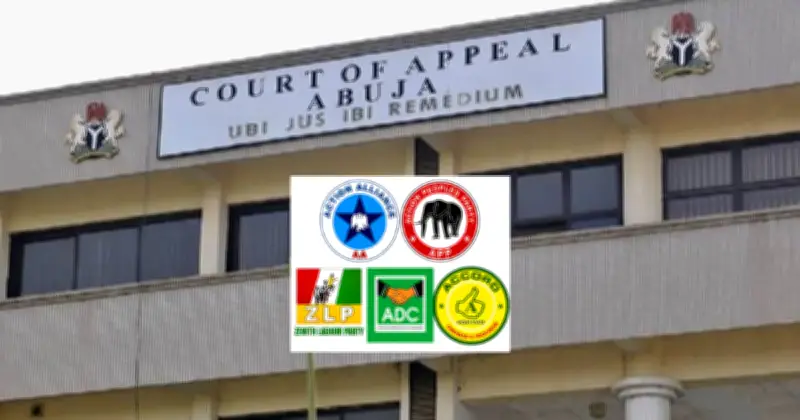
The Court of Appeal has delivered a landmark ruling that restores the legal recognition of five political parties previously deregistered by a Federal High Court order. The decision voids the deregistration directive against the African Democratic Congress (ADC), Accord Party, Action Alliance (AA), Action Peoples Party (APP), and Zenith Labour Party (ZLP), allowing them to fully participate in elections ahead of the 2027 general elections.
Full List of Parties Restored
The appellate court overturned the earlier High Court ruling that had declared these parties deregistered. The full list includes:
- African Democratic Congress (ADC)
- Accord Party
- Action Alliance (AA)
- Action Peoples Party (APP)
- Zenith Labour Party (ZLP)
Unless the Supreme Court intervenes, these five parties remain duly registered political entities under Nigerian law, with all associated rights and privileges.
Why Were the Parties Deregistered?
The controversy began when Justice Peter Lifu of the Federal High Court in Abuja ordered the deregistration of the five parties, citing failure to meet constitutional requirements under Section 225A of the 1999 Constitution (as amended). The court directed the Independent National Electoral Commission (INEC) to withdraw their recognition. The judgement particularly alarmed the ADC, which had become a key vehicle for an emerging opposition coalition gearing up for the 2027 elections.
Court of Appeal’s Reasoning
The Court of Appeal found fundamental flaws in the lower court's decision. It ruled that the Federal High Court lacked jurisdiction because the suit was filed by a non-juristic entity—an entity without legal capacity to sue. Consequently, the case was incompetent, invalidating all orders deriving from it, including the deregistration directive. The appellate court also noted that the lower court failed to properly evaluate evidence that the parties had previously won elective offices, which was relevant to their constitutional standing. In strong language, the court described the lower court's conduct as a form of "judicial impertinence," referencing Supreme Court precedents that caution against exceeding jurisdictional limits.
Impact on INEC
INEC can no longer rely on the Federal High Court judgement to treat the five parties as deregistered. The electoral commission must continue to recognize their registration, leadership structures, and eligibility to field candidates. This is especially significant as preparations for the 2027 elections—including coalition negotiations, party congresses, and candidate selection—intensify.
Reactions and Significance
Former Vice President Atiku Abubakar welcomed the ruling, calling it a "landmark victory" that removed legal obstacles to the ADC's participation in the next general elections. Senator David Mark, the ADC National Chairman, praised the decision as a "victory for democracy, constitutionalism and the rule of law." The ADC has attracted national attention as the platform for a growing opposition coalition. The restoration allows the party to continue membership drives, fundraising, and internal elections without the immediate threat of deregistration.
Possibility of Supreme Court Appeal
The Court of Appeal’s decision is not necessarily final. Dissatisfied parties may appeal to the Supreme Court within the stipulated legal timeframe. Until a successful appeal or a stay of execution is granted, the appellate court's ruling remains binding. The judgement reinforces the constitutional principle that decisions affecting political parties must follow due process, and courts cannot issue far-reaching orders without jurisdiction.
Broader Implications for 2027 Elections
While the ruling does not determine electoral outcomes, it preserves political pluralism and provides greater certainty for voters, aspirants, and party officials. With five parties now legally active, the political landscape remains competitive, and the opposition coalition led by the ADC can proceed with campaign plans. The judgement also serves as a check on arbitrary deregistration, ensuring that only proper legal procedures can strip parties of their status.