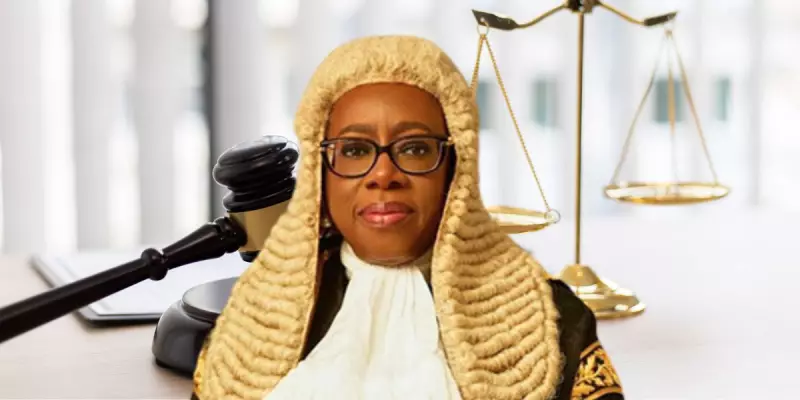
The Chief Justice of Nigeria (CJN), Justice Kudirat Kekere-Ekun, has issued a strong directive to courts across the nation to immediately begin conducting virtual hearings of cases. This urgent call aims to address the crippling backlog of cases that is delaying justice for thousands of Nigerians.
A Judicial System Under Pressure
The CJN made this declaration on Monday during the ceremony marking the opening of the 2025/2026 Legal Year for the Federal High Court. She expressed deep concern that traditional, in-person courtroom proceedings can no longer manage the overwhelming volume and complexity of cases awaiting judgment.
Justice Kekere-Ekun highlighted that the court's docket is now dominated by modern challenges, including technology-driven crimes, intricate financial disputes, cross-border commercial issues, terrorism cases, and new regulatory matters. She stated that these realities demand rapid adaptation from the judiciary, including new skills and stricter case management.
"Digitisation must therefore move from being viewed as a project-based intervention to a core institutional priority," the CJN asserted. She emphasized that tools like virtual hearings, electronic filing (e-filing), digital case tracking, and secure electronic records are no longer optional but are essential for a modern justice system.
Technology as a Tool for Transparency and Efficiency
The Chief Justice argued that embracing technology does more than just speed up processes. It also enhances accountability, predictability, and, crucially, public confidence in the judiciary. When court information is accurate, timely, and easily accessible, it reduces uncertainty and strengthens trust.
She commended the Federal High Court for launching its new digital systems, including an Information Electronic Directory Table and Electronic Notice Display Screens. These are not mere gadgets but represent a strategic shift towards transparency and user-friendly court administration.
The Electronic Display Notice Board provides a secure, official platform for sharing court information in real-time, such as daily case lists and official announcements. The interactive Directory Table helps visitors navigate the court premises efficiently, reducing congestion and delays.
"Together, these systems promote dignity, efficiency, accessibility, and institutional coherence, which are values that must define the modern Nigerian Judiciary," Justice Kekere-Ekun added.
Stark Numbers and a Warning for 2027 Elections
The scale of the challenge was laid bare by the Chief Judge of the Federal High Court, Justice John Tsoho. He revealed that a staggering 165,905 cases were still pending at the end of the last legal year. This figure came from an initial carry-over of 161,999 cases, plus 19,925 new filings, out of which only 16,019 were disposed of.
With the 2027 general elections on the horizon, the CJN issued a stern warning to judges against the abuse of interim injunctions. She stressed that election-related cases must be handled with utmost discipline and strict adherence to legal timelines.
"Conflicting interim orders, forum shopping, and the abuse of ex parte processes undermine the credibility of the entire justice system and weaken public confidence," she cautioned. The CJN insisted that the judiciary must never be seen as an arena for political manipulation but must remain a sanctuary of constitutional order.
She also addressed the persistent issue of delays, urging judges to be proactive managers of their courtrooms rather than passive moderators. The National Judicial Council (NJC) will intensify its oversight of case progression to enforce institutional discipline.
The Nigerian Bar Association Voices Public Frustration
Echoing the need for reform, the Nigerian Bar Association (NBA), represented by its President, Mazi Afam Osigwe, SAN, called for improved "institutional integrity." The association pointed to the daily frustration faced by citizens due to the unpredictability of court sittings.
The NBA described a common ordeal: litigants and lawyers waking before dawn, spending scarce resources on transportation, and braving insecure roads to get to court, only to be told the judge is not sitting or to have their case adjourned after hours of waiting. This experience, they stated, wastes time and resources, chips away at public faith, and makes justice inaccessible.
The constitutional guarantee of a fair hearing within a reasonable time cannot be met when litigants repeatedly face such avoidable disruptions, the NBA concluded.