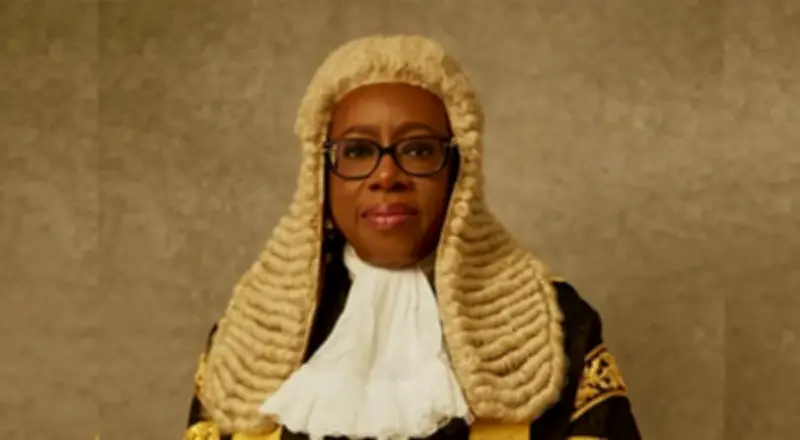
The Chief Justice of Nigeria (CJN), Kudirat Kekere-Ekun, has ordered a sweeping change in professional address: lawyers must no longer use the title 'Barrister' in front of their names, particularly in any official capacity connected with the Supreme Court.
The directive, embodied in a circular dated 13 July, was signed by the Chief Registrar of the Supreme Court, Kabir Akanbi, and came to public attention on Friday. It is addressed to all litigation staff, legal practitioners, court registrars, and lawyers who interact with the apex court. The CJN characterised the long-standing practice as inappropriate and inconsistent with the professionalism expected of the Nigerian bar.
"I am directed by the Honourable the Chief Justice of Nigeria to notify all Litigation Staff, Legal Practitioners, Court Registrars, and Lawyers that the use of the title 'Barrister' as a prefix to names is inappropriate and inconsistent with the standards of professionalism expected within the Supreme Court of Nigeria," the circular read in part.
What the Circular Orders
The circular is unequivocal in its mandate. All concerned officers must immediately discontinue the usage of 'Barrister' before their names in every official context. This includes official correspondence, records, documents, identity materials, and any other official engagements. The order carries immediate effect, with no transition period.
"Consequently, all officers concerned are hereby directed to discontinue the use of the title 'Barrister' before their names in all official correspondence, records, documents, identity materials, and any other official engagements with immediate effect," the circular stated. It further directed department and unit heads to ensure strict compliance among their subordinates.
The instruction was framed as a binding administrative imperative. The phrase "Please be guided accordingly" underscores that the CJN expects the legal community to treat the change as authoritative, not advisory.
Why 'Barrister' Was a Misnomer
The title 'Barrister' has been a fixture in Nigeria's legal culture for decades. Many lawyers routinely prefix it to their names on letterheads, business cards, and even in courtroom intros. Yet, the term does not officially function as a title anywhere in the common-law world. In Britain, where the term originates, a barrister is simply a lawyer who is qualified to argue cases in higher courts. The word describes a role, not a rank or honorific.
In Nigeria, the legal profession is fused, meaning every lawyer is both a barrister and a solicitor of the Supreme Court of Nigeria. This dual enrolment is one of the reasons the use of only 'Barrister' is seen as incomplete and, according to the CJN, unprofessional. By contrast, in England and Wales, the profession is split: barristers specialise in advocacy, while solicitors provide legal advice and handle paperwork. Neither group utilises 'Barrister' as a title before their names.
The widespread familiar use of 'Barrister' So-and-so in Nigeria had grown through decades of unspoken acceptance. Courts and regulatory bodies overlooked the practice, which gave it a veneer of legitimacy. The newly public circular shatters that unofficial acceptance, at least within the Supreme Court's official sphere.
What About 'Esquire'?
Nigerian lawyers also commonly append the postnominal 'Esq.' (Esquire) to their names as a professional courtesy. The term, however, is not a legal title either. In ordinary usage, 'Esquire' is a formal address placed after a man's name, particularly in the recipient line of official letters — historically equivalent to a gentleman's rank.
While any man could technically adopt 'Esq.' as a courtesy, Nigerian legal practice has reserved it, regardless of gender, for members of the bar. It has become a marker of identity. But the CJN's latest circular does not touch 'Esq.' It focuses solely on the prefix 'Barrister'. This suggests that the judiciary's concern lies with what precedes a lawyer's name, not what follows it — perhaps because prefixing creates the false impression of a professional title.
Potential Ripple Effects
The directive applies explicitly to engagements with the Supreme Court, but its language is broad. The CJN is the head of Nigeria's entire legal profession, so the ruling could influence how lawyers present themselves in all courts, not just the highest one. Bar associations and law firm administrators are likely to watch how the Supreme Court enforces the rule and may voluntarily align their own internal documentation.
For the average Nigerian lawyer, this means relearning a lifelong habit. The transition could be particularly pronounced among senior advocates who have styled themselves 'Barrister' for decades. However, the directive does not criminalise the use in casual conversation, only official dealings with the court system. Whether the trend will eventually lead to a nationwide ban on the title remains to be seen.
The circular, dated 13 July, marks a notable shift in judicial oversight of professional self-presentation. By grounding the decision in established legal norms, the CJN aims to remind the bar that authenticity and precision matter as much in address as they do in argument.