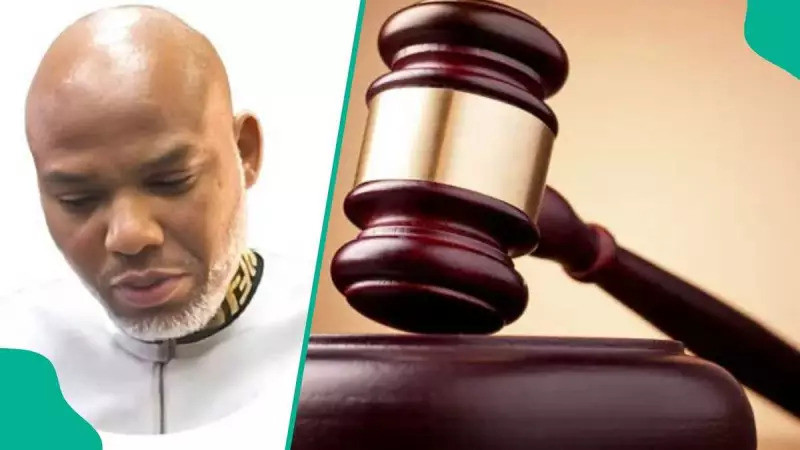
The Federal High Court sitting in Abuja has firmly dismissed a fresh attempt to secure the transfer of the convicted leader of the proscribed Indigenous People of Biafra (IPOB), Nnamdi Kanu, from the Sokoto Correctional Centre.
Motion Rejected on Technical Grounds
On Thursday, December 4, Kanu's younger brother, Emmanuel Kanu, appeared before Justice James Omotosho to personally move a motion filed on behalf of the detained IPOB leader. The motion sought to challenge Kanu's continued detention in Sokoto and argued for his transfer to Abuja to facilitate the effective prosecution of his appeal.
Emmanuel Kanu informed the court that he was standing in for his brother and urged the judge to proceed with the hearing in the convict's absence, stating it would serve the interest of justice.
However, Justice Omotosho swiftly declined to grant Emmanuel an audience. The judge ruled that Emmanuel Kanu, not being a legal practitioner, was not qualified to move such a motion before the court.
"This ex parte motion cannot be moved on the convict’s behalf because you are not a legal practitioner," Justice Omotosho stated, effectively striking out the push for the prison transfer.
Background: Kanu's Conviction and Sentence
This latest court proceeding follows the landmark judgment delivered by the Federal High Court on Thursday, November 20. Justice Omotosho had found Nnamdi Kanu guilty on multiple counts of terrorism-related offences.
The court handed down the following sentences:
- Life imprisonment on Counts 1, 4, 5, and 6.
- 20 years' imprisonment on Count 3.
- 5 years' imprisonment on Count 7.
All sentences are to run concurrently, and none carried an option of a fine. In a significant additional ruling, the court ordered that Kanu be denied access to digital services like phones, laptops, and tablets. Any such access would be solely at the discretion of the National Security Adviser (NSA).
Secession Agitations in Historical Context
The case of Nnamdi Kanu sits within Nigeria's long history of managing secessionist agitations, a challenge for the multi-ethnic nation. Such movements have been a feature of the country's politics since soon after independence, most notably leading to the Nigerian Civil War which lasted for two and a half years.
In contemporary times, figures like Kanu have led renewed calls for separation, with the IPOB leader now joining others who have faced incarceration for their roles in these agitations. The court's firm stance in this recent hearing underscores the judiciary's current approach to such legal challenges stemming from these deep-seated national issues.