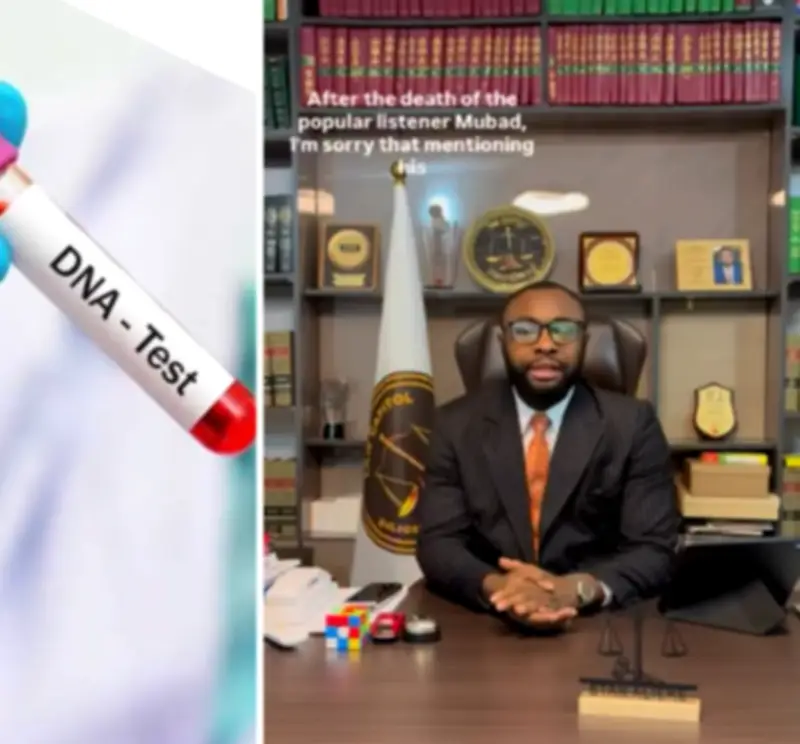
An Abuja-based legal practitioner, Stan Alieke, has ignited a fierce online debate after asserting that DNA tests hold secondary status under Nigerian law when determining child paternity.
In a viral video, the lawyer explained that Nigerian courts rely more on traditional customs and marriage rules to decide who a child's father is, rather than scientific tests. According to Alieke, DNA tests are only used as backup evidence under the country's current laws.
Legal Presumption of Paternity in Marriage
He explained that under Nigerian law, any child born within a valid marriage is automatically presumed to be the husband's biological offspring. This legal presumption extends beyond the marriage itself, dictating that if a child is born within 280 days of a divorce, the ex-husband is still legally presumed to be the father.
Alieke emphasized that this presumption is a cornerstone of statutory law, designed to provide certainty in family relations and protect the interests of the child. The 280-day rule, he noted, is a codified standard that courts apply uniformly, regardless of biological evidence.
Customary Traditions in Paternity Rulings
Furthermore, Alieke highlighted how Nigerian courts incorporate cultural traditions into paternity rulings. He noted that in Yoruba, Hausa, and Fulani customs, public acts of acknowledgment—such as conducting a traditional naming ceremony or letting a child bear a man's surname—solidify legal fatherhood regardless of biological proof.
In contrast, Igbo custom ties paternity directly to marital transactions, meaning once a man pays a woman's bride price, he is legally presumed to be the father of any child she bears. These customs, Alieke argued, are deeply embedded in the legal framework and often carry more weight than DNA results in judicial decisions.
DNA Testing as Secondary Evidence
Concluding his analysis, Alieke reiterated that modern DNA testing remains foreign to the core foundations of Nigerian customary and statutory laws. While admissible in court, it is generally treated as a secondary source of evidence that is often subordinate to established matrimonial presumptions and deep-rooted cultural customs.
His remarks have sparked widespread reactions online, with many debating the role of science versus tradition in Nigerian family law. The video, shared via Linda Ikeji's blog, continues to draw commentary from legal experts and the public alike.