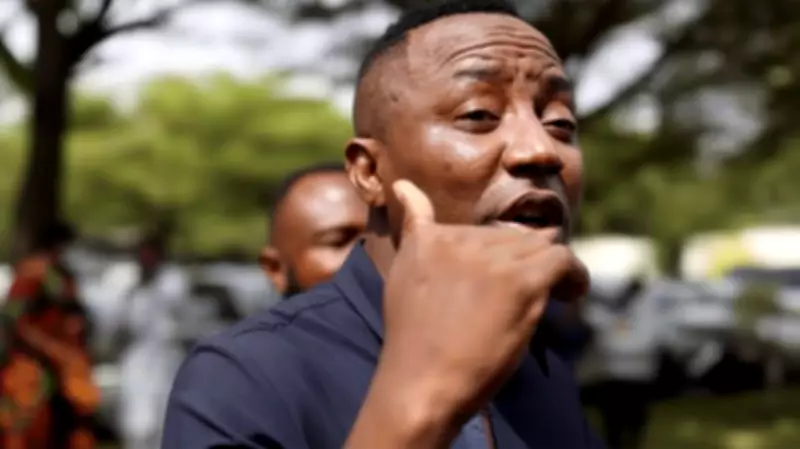
Examining Omoyele Sowore's Activism and the Boundaries of Judicial Respect
Every generation produces non-conformists who play a crucial role in shaping society and holding governments accountable to the people. Omoyele Sowore has been a prominent activist since his days as a students' union leader at the University of Lagos. During his tenure, he was known for his vibrancy, proactivity, and unwavering commitment to student welfare. He eventually rose to become President of the UNILAG Students' Union and a member of the Senate of the National Association of Nigerian Students (NANS).
From his public profile, Sowore hails from the Niger-Delta region of Ondo State and attended UNILAG between 1989 and 1994. He holds a post-graduate degree in Public Administration from Columbia University. In 2006, he founded the media platform Sahara Reporters, aimed at exposing corruption and promoting accountability in Nigerian governance. Without a doubt, Sowore revolutionized media coverage in Nigeria, daring to venture where traditional media often hesitated.
Political Ambitions and Movements
Sowore founded the African Action Congress as a political party in 2018 and has contested presidential elections in 2019 and 2023 through this platform. He launched the #RevolutionNow movement in 2019, which has positioned him against successive administrations in Nigeria. Additionally, he co-founded the #TakeItBack movement with other notable comrades to challenge what they describe as political vultures.
From various perspectives, Sowore represents different things to different people, depending on the narrative. In a humble view, the government should allow Sowore to operate freely. It is considered oppressive and brutal to deploy the full arsenal of government power against a single individual to muzzle, silence, and render him voiceless. The comrade politician is just one among two hundred million people seeking change through purposeful leadership that aligns with the yearnings and aspirations of Nigerians.
The criminal charges filed against Sowore at the government's behest are numerous, leading to restrictions on his fundamental rights to movement, privacy, freedom of expression, and political activities. It is possible that Sowore specializes in unconventional methods that the government is either unaccustomed to or uncomfortable with, but this is normal in a democratic setup, provided they are conducted within legal confines.
Recent Courtroom Controversy
The purpose of this piece is to examine recent developments involving Sowore and the judiciary. On March 24, 2026, Sowore appeared before the Federal High Court in Abuja. According to accounts, he had no scheduled case that day but was there to confirm the date of a previously scheduled hearing. From a video that circulated online, Sowore addressed the press inside the courtroom, an action that is not in dispute.
Also present in court that day was Comrade lawyer Mr. Musbau Adetunmbi, a Senior Advocate of Nigeria. His attempt to caution Sowore against conducting an interview inside the courtroom was rudely rebuffed by Sowore, who then proceeded to disparage his rank and status as a learned senior member of the Bar. In the video, Mr. Adetunmbi, SAN, was properly robed and seated in the Inner Bar, likely waiting for the judge to commence proceedings.
In what appeared to be a total disrespect for the Bench and the Bar, Sowore sat on the desk of the Inner Bar and unleashed unbridled verbiage on the learned SAN, who remained calm and composed in his responses. This encounter has sparked numerous articles and opinions in the public space, particularly regarding the propriety of conducting a press interview within the courtroom.
Legal and Ethical Considerations
The courtroom is a public space for access by all, subject to the overriding direction of the presiding judge, who is regarded in law as the master of the court. For various reasons, individuals can be barred from attending court sessions. Freedom of expression and the press is guaranteed under section 39(1) of the 1999 Constitution, with stipulated restrictions. First, one must have a registered outfit or platform, and second, that freedom is subject to conditions set by law or authorities, including the overall direction of the court or judge.
The courtroom cannot serve as a media center, and no form of media activity is allowed inside except as authorized by the judge. In the recent 2023 Presidential Election Petition, the issue of live media coverage of court proceedings was raised and duly addressed by the court. It is gratifying that the Nigerian Bar Association has spoken eloquently in condemnation of Sowore's actions, cautioning him not to turn the courtroom into a stage for publicity, advocacy theatrics, or confrontation inconsistent with judicial discipline.
While it is appreciated that Sowore is not a lawyer trained in legal ethics, he has been in and out of courtrooms enough to become familiar with acceptable conduct. He even boasted that he has his own SANs, though it is uncertain if he addresses them in the same manner as he did Mr. Adetunmbi, SAN, on that fateful day. The sanctity of the court cannot be sacrificed on the altar of media theatrics or political grandstanding.
Historical Context and Judicial Reliance
Countless times, Sowore has addressed the press on the premises of various courts, and no one has ever stopped him from lawfully exercising such rights. However, turning the courtroom into a press center, where even the Inner Bar is desecrated, is totally unacceptable, and Sowore is fully aware of this. On December 6, 2019, operatives of the Directorate of State Security (DSS) invaded the Federal High Court in Abuja, where Sowore was standing trial. He had been granted bail, but the DSS refused to release him, prompting the judge to order his production in court within 24 hours.
Upon his release by the court on that occasion, the DSS attempted to arrest Sowore right inside the courtroom. Sowore resisted this unlawful act and mobilized his lawyers, supporters, and other Nigerians in court to stop it. His reasoning then was that he could not be arrested inside the courtroom, which was correct, but he is wrong in the present circumstance. Once the judge loses control of the court, the authority of that court is threatened, which is why judges are empowered to bar certain persons from access in appropriate cases.
Another point Comrade Sowore must note is that the judiciary is an institution that should be protected and preserved at all costs. Individual members may be found wanting for misconduct, but this should not lead to the balkanization or condemnation of the entire legal system and its sustaining institutions. Recently, the Commissioner of Police in Lagos State declared Sowore wanted and issued an unlawful order for him to stay away from Lagos. Sowore sought refuge in the Federal High Court in Lagos, and the judiciary rose in his defense, stopping the unwarranted police aggression.
Not only was judgment delivered in his favor, but the court also ordered the police to pay compensation of Thirty Million Naira to Sowore. It is left to be imagined whether Sowore offered any bribe or gratification to secure that judgment. By all definitions, that court is part of the Nigerian judiciary that Sowore condemns and castigates daily. Without doubt, there will be other instances when Sowore will rely on the judiciary to rescue him from oppressive government conduct and policies.
Conclusion: The Limits of Activism
If we close our eyes because of bad people, good people will pass us by unnoticed. We cannot pull down the judicial institution simply because of isolated cases of alleged corruption, which at best constitute the exception rather than the norm. From personal experience, patriots throughout history have always relied on the judiciary (Bar and Bench) to save them from persecution. From the agitation for independence to campaigns against military rule and civilian dictators, the courts have stood tall in support of nationalists and activists against dictatorial tendencies and oppressive policies.
It is therefore not a good strategy for anyone involved in mass mobilization for revolution or with an agenda to take back the government from primitive undertakers to wage unnecessary war against lawyers and judges. This is nothing but self-immolation. Let Comrade Sowore beware of the limits of activism. Wisdom is not cowardice, and it is always profitable to direct efforts appropriately. Adegboruwa is a Senior Advocate of Nigeria (SAN).