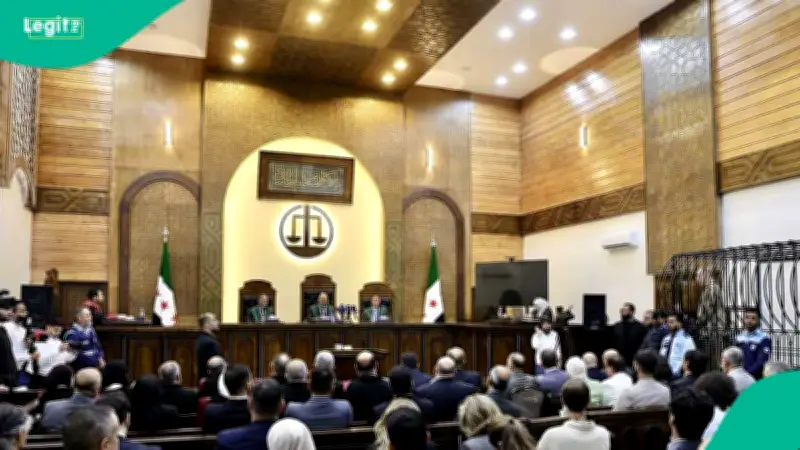
A Syrian court has sentenced ousted President Bashar al-Assad and his brother Maher al-Assad to death in absentia for crimes against humanity and war crimes committed during the country's 14-year civil war, in which about half a million people were killed. The verdict was announced on Monday, according to Syrian state media, marking a landmark step in the country's pursuit of transitional justice.
Details of the Verdict
The court ruled that Bashar al-Assad was guilty of the "premeditated and intentional murder of more than one person and of children," as well as torture, arbitrary arrest, and crimes against humanity. Maher al-Assad, who commanded the feared Fourth Division and was considered one of the regime's most powerful security officials, received the same sentence for his role in the brutal crackdown on civilians.
The two brothers fled to Moscow after being ousted by a lightning rebel offensive in December 2024 that toppled the Assad regime in just 11 days. The court's decision comes as Syrian authorities said they would pursue international legal avenues to prosecute the brothers, although Russian officials have previously rejected requests to extradite the former Syrian allies.
Additional Sentences and Context
The court also sentenced Atef Najib, Assad's cousin and former head of political security in Daraa, to death. Najib was accused of ordering the torture of 15 young boys who had written anti-Assad slogans on a wall in 2011. That incident became a major trigger for mass protests in the southern Syrian province before the unrest spread across the country.
Najib's trial attracted significant public attention, with images showing him listening to proceedings while dressed in a prison uniform and held inside a cage in the courtroom. The Syrian government has described the trial as a landmark case in its efforts to pursue transitional justice, which experts say will be crucial to addressing the deep divisions created by years of conflict.
Post-Assad Violence and Transitional Justice
Syria has continued to experience outbreaks of violence in the post-Assad era. About 1,500 people, mostly Alawite civilians, were killed in a wave of retaliatory violence in March 2025 after militants loyal to Assad attacked security forces. Assad belonged to the Islamic Alawite sect, a minority group in Syria that maintained strong support for his government in the country's coastal heartland during his rule.
In July 2025, more than 1,700 people were killed in massacres in Suweida, a Druze-majority province, after local clashes escalated into sectarian violence. Low-level violence has continued in northern Syria, with Alawite civilians particularly targeted.
Since the fall of the Assad regime, Syrian authorities have taken steps towards transitional justice, including establishing committees and arresting officials associated with the former government in an effort to address past abuses and prevent further intercommunal violence.
Background on Assad's Rise and Rule
Bashar al-Assad became president in 2000 at the age of 34, succeeding his father, Hafez al-Assad. He had trained as an ophthalmologist in London and was not initially expected to become president, but became the heir apparent after his elder brother, Basil, died in a car accident.
Initially portrayed as a young reformer who could bring greater political and economic liberalisation to Syria, Assad's legacy ultimately became defined by his government's violent response to the 2011 uprising. Under his rule, Syria's extensive security apparatus was accused of operating with little restraint, carrying out widespread arrests, torture and killings against civilians on a large scale.