Women's rights groups and gender inclusion advocates have expressed renewed optimism that the National Assembly will pass the Reserved Seats for Women Bill, arguing that the proposed constitutional amendment could help address decades of underrepresentation of women in Nigeria's political institutions.
Rally at National Assembly
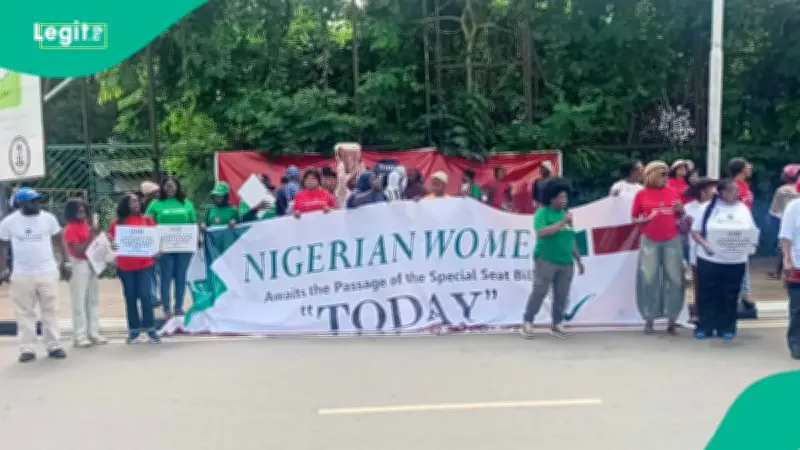
The campaigners made the call during a rally at the National Assembly on Thursday, June 11, urging lawmakers to support what they described as a landmark reform aimed at making governance more inclusive and reflective of Nigeria's population.
Their confidence comes despite the bill not being put to a vote during the latest plenary session of the House of Representatives.
Bill Remains on House Agenda Despite Delay
National chair of the Women's Political Participation Technical Working Group (TWG), Ebere Ifendu, said the proposal remains on the House order paper and is expected to be considered when lawmakers return from recess on July 7.
According to her, the delay was caused by time constraints during deliberations on several constitutional amendment bills, as well as disagreements among lawmakers on other matters before the chamber.
"The Special Seats Bill remains on the order paper and will be considered when the Assembly resumes. We remain optimistic and committed to engaging lawmakers and the media to ensure its passage," Ifendu said.
She noted that a key development in the amendment process was the inclusion of two additional Senate seats for women in each of Nigeria's six geo-political zones, bringing the proposed number of reserved seats in the upper chamber to 12.
Ifendu described the proposal as one of the most significant efforts yet to increase women's participation in governance and urged supporters to maintain momentum.
"We ask all advocates and partners to stay steadfast. This bill is closer to passage than ever before," she added.
Campaigners Say More Women in Parliament Will Strengthen Democracy
President of the Nigeria League of Women Voters (NILOWV), Irene Awunah-Ikyegh, said the bill presents an opportunity for Nigeria to strengthen democratic representation by ensuring that women's voices are better reflected in legislative decision-making.
"For us, there is no better time to pass this bill than now. Having more women in parliament is a sign that Nigeria wants inclusive policies and governance that reflects the diversity of its population," she said.
Awunah-Ikyegh expressed confidence that members of the 10th National Assembly would support the proposal and leave a lasting legacy on democratic reforms.
"We believe the 10th Assembly is ready to write its name in the history books by taking this important step. Women will provide quality representation and bring perspectives that will enrich legislative debates and decision-making," she added.
Veteran gender advocate and founder of the Ene Obi Development Centre (EODC), Ene Obi, also expressed confidence that lawmakers would back the measure following months of engagement between women's groups and legislators.
"We are very optimistic that they will pass it this time because it will increase inclusion, and that is what we are looking for. The more women we have in governance, the better represented our society becomes," Obi said.
She added that women's organisations would continue to support lawmakers who champion the bill and seek re-election in future electoral cycles.
Proposal Could Significantly Expand Women's Presence in Politics
If approved, the constitutional amendment would create 12 additional Senate seats reserved for women and 37 new seats in the House of Representatives.
The proposal also seeks to establish three additional seats for women in each of Nigeria's 36 State Houses of Assembly, creating 108 new positions at the state level.
Supporters say the measure is intended as a temporary intervention to address historical barriers that have limited women's participation in politics and public decision-making.
The bill further proposes an indirect election system for the reserved seats through Electoral Colleges supervised by the Independent National Electoral Commission (INEC).
Advocates argue that the reform could help reverse Nigeria's poor record on female political representation, where women occupy only a small proportion of elected offices despite making up nearly half of the country's population.