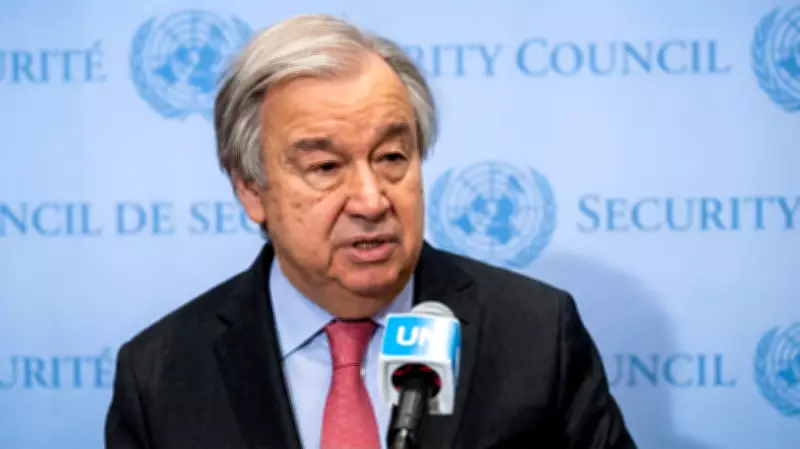
The United Nations is facing an existential financial crisis, with Secretary-General António Guterres warning that the organization could collapse if member states do not urgently pay their dues. The warning has sparked widespread concern among stakeholders about the UN's ability to sustain its programs and activities.
Financial Crisis Deepens
In a recent letter to member states, Guterres highlighted that the financial crisis is deepening and could soon lead to a collapse. He attributed this to the failure of member states to pay their mandatory dues and UN budget rules that require returning unspent funds. Officials say this has put the organization on an unsustainable trajectory. Under UN financial law, about $300 million in budget credits must be returned, triggering a liquidity crisis, especially with the withdrawal of the United States under President Donald Trump from 66 international organizations, including 32 UN entities.
Despite over 150 member states paying their dues last year, the year ended with $1.56 billion in outstanding dues, double the previous year. The US decision to cut voluntary funding and withhold mandatory payments to both regular and peacekeeping budgets, citing inefficiency and contrary to its interests, has brought the UN to a breaking point. The US accounted for 22 percent of the UN's core budget, and its withdrawal has left the organization short of cash reserves.
Experts Call for Reform
Stakeholders have urged the UN to urgently rethink its funding structure and institutional priorities. Former Nigerian Ambassador to the US, Joe Keshi, described the situation as worrisome, noting that the world has over-depended on the US for 80 years. He called on member states to pay their dues and eliminate corruption, emphasizing that countries like China should step up as the number one contributor. Keshi added that the US withdrawal does not prohibit it from leaving, but it must pay all debts before exiting.
Environmental sustainability expert Anngu Orngu said the crisis exposes weaknesses in the UN's internal planning and preparedness. He noted that the UN has promoted sustainability globally but failed to apply it to its own operations. Orngu called for the UN to engage other wealthy nations more seriously and for African countries to invest in industrialization to reduce dependence on foreign aid.
Public Affairs Analyst Olisa Adekoya cautioned the UN against being drawn into geopolitical rivalries, stressing that neutrality remains central to its relevance. He warned that the UN could run out of operational funds by July 2026, with its New York Headquarters facing possible shutdown by August if urgent funding gaps are not addressed, especially with over $4 billion owed by the US in combined regular and peacekeeping budgets. The situation has already resulted in hiring freezes, a 15 percent reduction in peacekeeping operations for 2025–2026, and threats to major events such as the UN General Assembly.
Way Forward
Keshi urged member states to pay up, saying that if they do, the UN will survive and shame the US. He advised that even partial payments can help ensure the organization's survival until the US returns. Orngu emphasized that the crisis offers an opportunity for the UN to adopt self-sustaining financial models. Adekoya called for the UN to maintain its mediating role and avoid partisanship.