
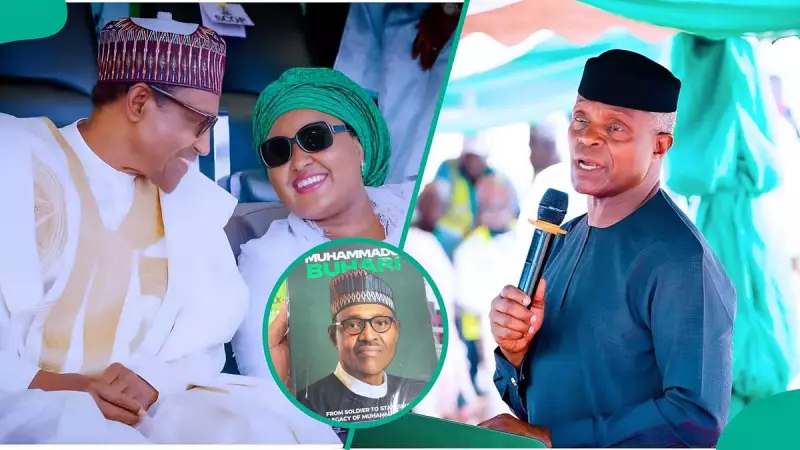
A new biography of Nigeria's late former President Muhammadu Buhari has ignited a fierce debate about the true nature of his eight-year partnership with former Vice President Yemi Osinbajo. The book, launched at the Presidential Villa in Abuja and attended by President Bola Tinubu, makes startling claims that challenge the public record of one of Nigeria's most stable presidential duos.
The Marketplace of Posthumous Narratives
Nigeria has developed a thriving economy built on the silence of departed leaders. When powerful figures exit the stage, particularly through death, the void they leave becomes an open marketplace for trading motives, conspiracies, and convenient truths. In this space, evidence is rarely provided, but storytellers deliver their accounts with unwavering confidence.
The biography titled From Soldier to Statesman: The Legacy of Muhammadu Buhari, authored by Charles Omole, director-general of the Institute for Police and Security Policy Research, has eagerly occupied this territory. Since its launch, social media and political circles have been abuzz with discussions about its revelations.
Among the most discussed claims is an assertion attributed to former First Lady Aisha Buhari that the late president once locked his bedroom door over gossip that she wanted to kill him. This anecdote, described as almost cinematic, reveals how rumor can distort even the most intimate relationships when it circulates around centers of power.
The Central Claim: A Withheld Endorsement
At the heart of the controversy is a deceptively simple claim: Muhammadu Buhari did not endorse Yemi Osinbajo's bid for the presidency in 2023. The book suggests he did not openly oppose or campaign against his vice president, but simply withheld his support.
This carefully worded accusation—soft enough to sound reasonable yet sharp enough to wound—is now being presented as settled fact. The authority comes from its presentation in a published biography and through statements attributed to Aisha Buhari, who presumably had intimate access to the former president's private thoughts.
The book's logic presents Buhari as viewing Osinbajo primarily as Tinubu's man. It claims he found it odd that Osinbajo would run when his political benefactor was also in the race and that the vice president merely informed him of his ambition rather than seeking guidance.
Contradicting the Public Record
This posthumous narrative stands in stark contrast to eight years of documented partnership between the two leaders. From 2015 to 2023, Buhari and Osinbajo maintained what many observers described as one of Nigeria's most stable presidential partnerships.
The public record shows numerous instances of trust and delegation:
- In February 2016, Buhari voluntarily handed over power to Osinbajo during a short vacation.
- During Buhari's prolonged medical leave in 2017, Osinbajo effectively ran the country, earning praise from the president upon his return.
- When Osinbajo, as Acting President, dismissed the Director-General of the DSS in 2018, Buhari resisted pressure to reverse the decision to protect institutional integrity.
Buhari consistently praised Osinbajo's leadership of the National Economic Council, his role in Social Investment Programmes, and his stewardship of the Economic Recovery and Growth Plan. He commended Osinbajo for spearheading the Ease of Doing Business initiative that moved Nigeria up 39 places on the World Bank index.
On multiple occasions, Buhari publicly described his deputy as loyal, dependable, and admirably competent. In a personal letter after a campaign incident, he wrote, "I'm proud of our partnership and your unalloyed loyalty." In May 2023, at the launch of a book about Osinbajo, Buhari described him as "a dedicated and loyal compatriot with a passion for excellence and service to the masses."
Questioning the Timing and Motives
The timing of these revelations raises significant questions. Why did these "truths" emerge only after Buhari's death, when he could no longer confirm, deny, or provide context? History teaches us to be wary of narratives that surface when rebuttal becomes impossible.
There is an uncomfortable sense that this might represent an arranged effort, sponsored and curated to serve present political interests. Aisha Buhari's emotionally powerful voice appears to have been co-opted to lend credibility to a specific narrative.
The irony is particularly striking given that Buhari himself once warned that biographies are often built on distortions and used as weapons against those one disagrees with. That statement now reads like an unintentional warning label for his own posthumous portrayal.
The man who was famously taciturn in life has become remarkably talkative in death through the voices of others. His restraint has been transformed into an open microphone, and his refusal to tell his own story has become a blank cheque for those eager to fill gaps with speculation and conveniently timed revelations.
This episode reveals less about Buhari or Osinbajo and more about Nigeria's appetite for retroactive certainty. There is an eagerness to collapse complex political relationships into neat moral conclusions once the principal actors can no longer speak for themselves. Posthumous truth, when stripped of balance and context, becomes less about historical accuracy and more about contemporary power dynamics. And power, as Nigerians have learned through experience, never tells stories innocently.




