
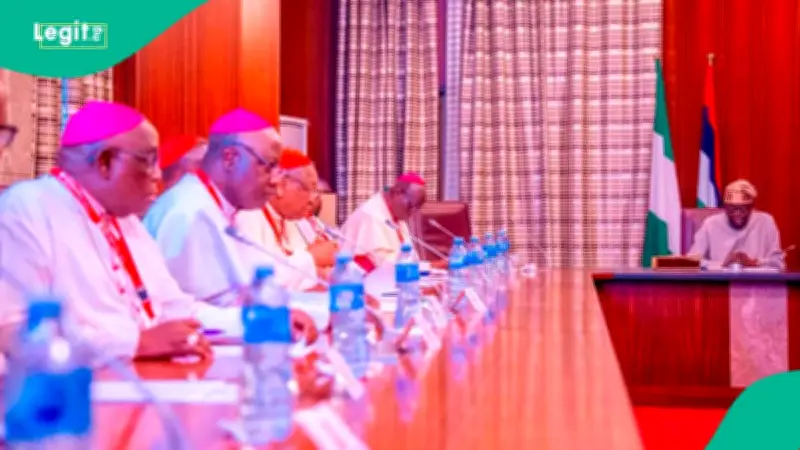
In a pointed opinion piece, Temitope Ajayi, Senior Special Assistant to President Bola Tinubu on Media and Publicity, has accused Cardinal John Onaiyekan of abusing clerical privilege by granting a television interview to give his own account of a private meeting between the Catholic Bishops' Conference of Nigeria and the President. Ajayi's critique, published on Legit.ng, argues that the cardinal's decision to appear on Arise News after the meeting breached the confidentiality and dignity of a private engagement.
The meeting itself had been requested by the bishops, who sought to present a catalogue of the country's economic, social, and security challenges. They were received graciously by President Tinubu, who listened patiently before responding point by point to each issue. While the bishops acknowledged the benefits of the Nigerian Education Loan Fund (NELFUND), they were largely dismissive of other achievements of the administration, according to Ajayi.
The President's Response on Schools and National Challenges
One of the thorniest issues raised by the bishops was the demand for the return of mission schools to their original owners. President Tinubu was reportedly surprised that such a matter was brought before him, given that it falls within the constitutional remit of state governments. He asked the bishops to take the request to the state governors and reminded them that he had personally returned mission schools in Lagos State during his tenure as governor.
Ajayi emphasised that the President did not claim Nigeria's problems had disappeared. Instead, he acknowledged that significant economic and security challenges remain, while pointing to measurable progress on several fronts. He argued that the country had emerged from "a dark tunnel" and that his administration had laid the foundations for recovery, with the next phase focused on ensuring that the greatest number of Nigerians feel the gains.
The presidential aide also took issue with the underlying assumption that the bishops' characterisation of the country's condition was the only valid one. He stressed that governing a country of more than 200 million people involves difficult choices, competing interests, limited resources, and imperfect options. No president, he wrote, can wave a magic wand and make accumulated problems disappear overnight.
Fiscal Stability and the Plight of Civil Servants
Ajayi argued that the President's policies have produced tangible results, particularly in restoring fiscal stability across many states. He noted that countless civil servants and pensioners who endured unpaid salaries and pensions for years are now receiving them more regularly. This was not the reality in many states from around 2014, and as recently as four years ago, 27 state governments struggled to meet their most basic obligations.
Many of those civil servants and pensioners are themselves parishioners in Catholic churches, Ajayi wrote. They know from lived experience that there has been real relief in the regular payment of salaries and pensions. While this does not erase the discomfort many Nigerians still face, it is wrong to dismiss such improvements casually.
The President's reminder of these facts during the meeting was not, as Cardinal Onaiyekan suggested, a sign of being aloof or dismissive. It was a presentation of evidence to support an argument that the country is not standing still. A disagreement over facts should not be interpreted as arrogance.
Security and the Limits of Public Information
On security, the bishops declared that Nigeria is bleeding, while the President thinks otherwise. Ajayi pointed out that President Tinubu did not deny the seriousness of the security situation but acknowledged the challenge while outlining the gains recorded by the Armed Forces and intelligence agencies across different theatres of operation.
As Commander-in-Chief, the President receives operational briefings, intelligence assessments, and battlefield reports that are unavailable to the general public. The bishops, like other Nigerians, rely largely on media reports and public information. That does not make the President infallible, but it does mean he possesses information that is not accessible to the generality of the people. It is therefore legitimate for him to argue that the overall picture is more nuanced than newspaper headlines sometimes suggest.
Ajayi also addressed a familiar error made by ideological and professional critics, who assume that only critics speak truth to power while everyone around a leader is either unwilling or incapable of doing so. He argued that this narrative is rarely true. The President has multiple channels for feeling the pulse of the country, including reading an average of ten newspapers every day and watching television discussion programmes. He receives daily security, social, and economic intelligence reports prepared for decision-making, which are not sugar-coated.
Does the President Need the Bishops to Speak Truth?
Ajayi revealed that in a meeting earlier in the week, President Tinubu had referenced a harsh and largely uninformed opinion piece written by Dr Chidi Amuta in his Sunday Thisday column. This, he said, demonstrated that the President is well aware of critical views. Beyond that, he has friends and associates embedded in the social fabric of the country, drawn from different regions, professions, and political persuasions, who serve as informal sounding boards.
The suggestion that President Tinubu somehow needs only the Catholic Bishops to acquaint him with the truth is an overreach, Ajayi argued. They are an important constituency, but they are by no means the exclusive custodians of the national mood or the nation's conscience. To assume that criticism delivered publicly is the only form of truth-telling is to misunderstand how government works.
Presidents are exposed daily to competing advice, conflicting intelligence, uncomfortable assessments, and hard realities. The real question is not whether they know the truth but what choices they make in response to it. The Catholic Bishops discharged what they considered their moral obligation by presenting their concerns, and President Tinubu accorded them respect by granting them an audience and responding to every issue.
The Obligation of Clerical Discretion
Ajayi concluded that reciprocity should have dictated that the confidentiality and dignity of the engagement be preserved. It was inappropriate, he wrote, for one of the participants to emerge almost immediately on national television to provide his own version of what was essentially a private conversation with the President. Clerical office carries privileges, but it also imposes obligations. Among the qualities the Scriptures require of bishops are temperance, maturity, self-restraint, and the wisdom to remain above needless public controversy.
Public influence should be exercised with discretion, not by converting privileged access into a platform for post-meeting commentary. The opinion piece, which was part of Legit.ng's diverse perspectives, does not necessarily reflect the editorial position of the organisation. The author, Temitope Ajayi, is a Senior Special Assistant to President Tinubu on Media and Publicity.




