
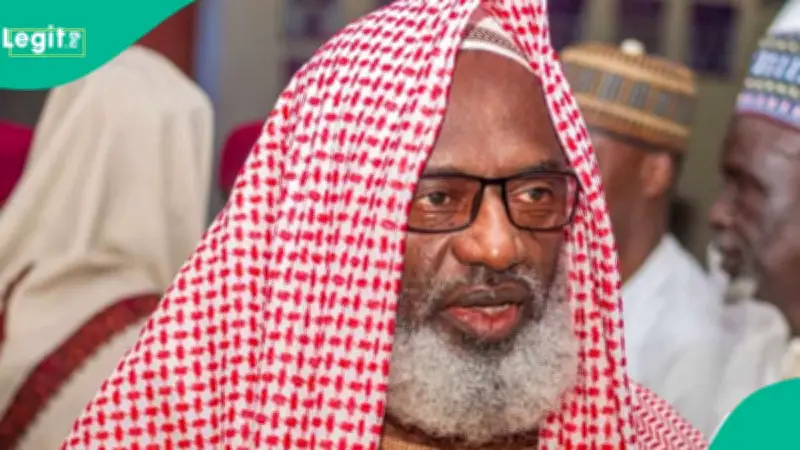
Sheikh Ahmad Abubakar Gumi, one of Nigeria's most prominent Islamic scholars, has weighed in on the contentious question of whether religious clerics should engage in partisan politics. In a Facebook post on Monday, August 3, 2026, Gumi asserted that clerics who involve themselves in politics and endure its hardships are superior to those who limit their role to praying for politicians from the sidelines.
The statement arrives amid an intensifying debate across northern Nigeria, sparked by a wave of Islamic scholars entering the political arena. The most prominent among them is former Minister of Communications and Digital Economy, Sheikh Isa Ali Ibrahim Pantami, who recently clinched the Peoples Democratic Party (PDP) governorship ticket in Gombe State for the 2027 general elections.
Gumi: Clerics Must Bear the Rigours of Politics
In his post, Gumi wrote: "A religious scholar who gets involved in politics and bears its rigours is better than one who sits on a prayer mat, offering prayers for politicians." This view directly challenges the traditional expectation that clerics remain detached from political affairs, devoting themselves exclusively to spiritual guidance.
Gumi's argument rests on the idea that the pressures and challenges of political participation test a scholar's character and resolve. Rather than sullying religious integrity, he suggests, engaging with governance allows qualified clerics to apply their knowledge and moral compass to real-world issues. A scholar who withstands the "rigours" of politics, public scrutiny, opposition attacks, and the burden of decision-making, can achieve far more than one who only offers prayers while politicians shape the nation's policies.
His stance has been interpreted as an endorsement of Pantami and others who have chosen to pursue electoral mandates, reinforcing the belief that clerics with leadership capacity have a duty to contribute directly to governance.
Pantami's Governorship Bid and the Growing Trend
Pantami, who served as Minister of Communications and Digital Economy under the previous administration, emerged as the PDP candidate for Gombe State's governorship race. His political move has been widely discussed, not least because he remains a respected Islamic figure. The 2027 election, for which his candidacy is set, is expected to be a closely contested race.
Pantami is not the only cleric seeking office. In February 2026, Sokoto-based Islamic scholar Sheikh Bashir Ahmad Sani also declared his intention to run for governor in his state. These examples highlight a notable shift in Nigeria's political landscape, where scholars are increasingly leaving the confines of mosques and classrooms to compete for public office.
The Debate: Morality vs. Impact
Opponents of clerical involvement in politics argue that the political arena is inherently divisive and morally compromising. They fear that partisan activity exposes religious leaders to public ridicule, vicious attacks, and defamation, which can irreparably damage their moral authority. For these critics, a cleric's power lies in independence; once a scholar becomes a politician, that independence is lost, and with it the ability to critique the government honestly from a position of moral strength.
On the other hand, proponents contend that meaningful reform cannot be achieved solely through external pressure. They argue that if a scholar possesses the knowledge, integrity, and competence to lead, confining that person to sermons and prayers wastes valuable human capital. They believe that qualified individuals have a responsibility to step into the corridors of power and drive change from within.
Gumi's remarks place him firmly in the latter camp. By valorizing clerics who bear the burdens of politics, he effectively encourages religious scholars to view political participation as a form of service rather than a fall from grace.
Gombe PDP Closes Ranks Behind Pantami
In Gombe State, moves are underway to unify the PDP behind Pantami. Monica Yahaya Kaltho, a governorship aspirant who had been disqualified from the party's primary, has withdrawn from the court case filed by aggrieved aspirants. She has now declared her full support for Pantami ahead of the 2027 elections.
Kaltho explained that her decision was influenced by consultations and a personal appeal from Senator Ibrahim Hassan Dankwambo, the PDP leader in Gombe State. She described Dankwambo as a father figure whose counsel she values greatly, and emphasized that preserving party cohesion and prioritizing the welfare of Gombe's people outweighed her personal political ambition. Her withdrawal is widely seen as an attempt to prevent internal divisions from weakening the party's chances in the upcoming gubernatorial contest.
What This Means for Nigeria's Political Culture
The increasing involvement of clerics in electoral politics adds a new dimension to Nigeria's democratic experience, particularly in the northern region where religious leaders enjoy considerable influence. For decades, scholars have shaped public opinion from the pulpit, but their direct entry into partisan contests blurs the line between religious authority and political power.
Gumi's public endorsement of this trend is likely to have implications beyond the current debate. It could encourage more Islamic scholars to consider political careers, altering the composition of political leadership. As the 2027 general elections draw closer, the intersection of faith and governance will remain a subject of intense scrutiny, with figures like Gumi, Pantami, and Bashir Sani at the center of the conversation.




