
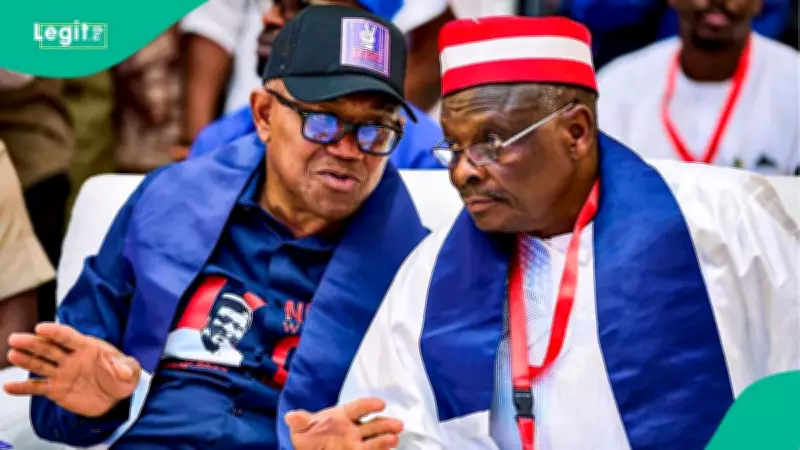
The maiden National Convention of the Nigeria Democratic Congress (NDC), held on May 9, 2026, at the Angeles Event Centre and Mall in Abuja, carried an unmistakable aura. It was not merely a gathering of politicians seeking electoral relevance; it was presented as a movement determined to reconnect politics with humanity, empathy, and national healing.
From the early hours of the day, Abuja assumed the atmosphere of a political festival. Thousands of supporters from across the 36 states and the Federal Capital Territory flooded the convention venue with chants, banners, and renewed optimism. The atmosphere was electric, yet purposeful. Unlike the cold and transactional conventions that have long defined Nigeria’s political culture, the NDC gathering projected the image of a party determined to speak the language of ordinary Nigerians: citizens battered by economic hardship, insecurity, unemployment, and political disappointment.
A Festival of Political Energy in Abuja
The convention was dominated by the dramatic arrival of the Kwankwasiyya and Obidient Movements, marking a significant and officially recognized political realignment ahead of the 2027 general elections. Though previously separate political movements, supporters of Rabiu Kwankwaso and Peter Obi, now popularly referred to by supporters as the “OK Movement,” were seen chanting “Obi-Kwankwaso” in a remarkable display of unity and shared purpose.
The alliance is widely perceived as an attempt to build a formidable “third force” coalition capable of challenging the ruling party in 2027. Both Obi and Kwankwaso are leveraging the NDC platform, which, for now, is free from the internal crises that plagued their former political parties.
The symbolism of the convention was impossible to ignore. Here was a newly registered political party, formally recognized by the Independent National Electoral Commission (INEC) only in February 2026, already commanding the attention of Nigeria’s political establishment. The presence of prominent figures such as Peter Obi, Rabiu Kwankwaso, and Seriake Dickson transformed the gathering from a routine convention into a major political statement.
Obi–Kwankwaso Alignment and the “Third Force” Question
Yet, beyond the political optics and strategic alliances, what truly distinguished the convention was the message it sought to communicate: that politics must once again wear a human face.
For years, Nigerians have watched politics drift dangerously away from the people. Elections became bitter struggles among elite blocs, while ordinary citizens were reduced to spectators and electoral statistics. Public trust collapsed under the weight of corruption, ethnic divisions, broken promises, and governance failures. Against this backdrop, the NDC convention attempted to project a different philosophy: leadership rooted not in domination, but in service; not in ethnic supremacy, but in fairness; not in power for its own sake, but in national renewal.
This philosophy was reflected in one of the convention’s most consequential resolutions: the zoning of the party’s 2027 presidential ticket to Southern Nigeria. Strategically, the decision acknowledged the delicate balance of Nigeria’s federal character and the growing demand for equity in power rotation. Politically, it signaled the NDC’s intention to position itself as a platform committed to justice, inclusion, and national cohesion.
Zoning, Leadership, and Early Power Moves
Early indications pointing to Peter Obi as the likely beneficiary of the zoning arrangement further deepened the convention’s emotional appeal, particularly among young Nigerians and the urban middle class. Obi’s political identity, built around prudence, accountability, and reformist ideals, aligns with the party’s attempt to present itself as a humane alternative to traditional power politics. Whether this momentum eventually translates into electoral victory remains uncertain, but the symbolism is already powerful.
Equally significant was the ratification of the Senator Cleopas Moses-led interim leadership as the substantive National Working Committee. In political movements, leadership legitimacy often determines longevity. By consolidating its internal structure early, the NDC appears determined to avoid the factional crises that have crippled many emerging political parties in Nigeria. The move projected organizational stability at a time when voters increasingly desire disciplined and ideologically coherent alternatives.
Perhaps the most compelling voice at the convention came from Kwankwaso, whose endorsement of the party’s decision to zone its presidential ticket to the South reinforced the NDC’s message of fairness and inclusion. His emphasis on national healing and leadership free from ethnic or religious bias struck at the heart of Nigeria’s deepest anxieties.
In a nation repeatedly fractured by identity politics, such rhetoric carries profound significance. Nigerians are wary of politicians who exploit religion and ethnicity during elections only to abandon governance afterward. The NDC’s messaging appeared deliberately crafted to challenge that old political order.
Nigeria’s Hard Realities Behind the Politics
In his speech, Kwankwaso painted a grim but honest portrait of Nigeria’s condition. He argued that the country remains dangerously unprepared in a rapidly changing world because of years of poor leadership and failed governance.
“While other nations reposition themselves within shifting global realities, Nigerians continue to endure worsening hardship at home,” he said.
His words resonated because they reflected lived realities. Insecurity has turned countless women into widows and left thousands of children orphaned. Entire communities have been displaced from their ancestral homes. Investments are declining, infrastructure is deteriorating, and the education system, once regarded as a ladder of hope, is collapsing under neglect.
Economic reforms introduced without adequate safety nets have deepened hardship, leaving ordinary citizens to bear the burden of policies they neither created nor benefited from. For many at the convention, these were not abstract political statements; they were deeply personal truths.
Amid the pain, however, the convention also offered something Nigeria desperately needs: hope rooted in history. Kwankwaso reminded the audience that even in the nation’s darkest moments, courageous political alliances had emerged to rescue the country from division and uncertainty.
The historic alliance between the Northern Elements Progressive Union (NEPU), led by Aminu Kano, and the National Council of Nigeria and the Cameroons (NCNC), led by Nnamdi Azikiwe, was recalled as an example of unity beyond ethnicity and regional interests. Equally significant was the coalition between the NCNC and the Northern People’s Congress (NPC), which helped secure Nigeria’s independence in 1960. The partnership between Shehu Shagari and Alex Ekwueme during the Second Republic was also invoked as proof that national healing becomes possible when leadership rises above division.
These historical references were more than historic nostalgia. They formed the philosophical backbone of the NDC’s message: that Nigeria can only survive through inclusion, fairness, and unity.
Perhaps the most powerful aspect of the gathering was its insistence that democracy cannot thrive when citizens remain passive. Delegates and party leaders passionately urged Nigerians to register with INEC, participate actively in elections, and become part of what they described as a noble national cause. It was not merely a call for political support, but a call for civic awakening.
That message matters because the greatest tragedy in Nigeria today may not simply be bad leadership, but the growing hopelessness among citizens. Many Nigerians no longer believe their voices matter. Many young people have emotionally withdrawn from the democratic process, convinced that politics benefits only a privileged few.
The NDC convention sought to challenge that despair. It attempted to remind ordinary Nigerians that they are neither invisible nor powerless.
Hope, Doubt, and the Test of the NDC Project
Politics often reveals itself through grand promises, loud slogans, and carefully rehearsed rhetoric. Yet, once in a while, a political moment emerges that feels less like a contest for power and more like a collective yearning for national rebirth. Beyond the applause and symbolism that greeted the convention lies the more difficult test of political sincerity.
Nigerian politics is littered with parties that began as revolutionary movements but eventually became indistinguishable from the systems they once condemned. This is the burden now facing the NDC. Can it truly sustain a politics with a human face when confronted with the ruthless realities of power, ambition, and electoral competition?
The answer will depend not on convention speeches, but on conduct. Nigerians will judge the NDC not merely by the popularity of its political figures, but by the quality of its internal democracy, its tolerance for dissent, the clarity of its policies, and its willingness to remain connected to the struggles of ordinary citizens long after the applause fades.
To speak of politics with a human face is to speak of governance that recognizes the dignity of the unemployed graduate, the struggling trader, the displaced farmer, the underpaid worker, and the hopeless young voter who has almost given up on democracy. It means building a political culture where citizens are seen not as tools for elections, but as the true owners of the democratic process.
That is why the NDC convention may represent more than the birth of another opposition platform. It may reflect a growing national hunger for a different political ethos: one anchored on empathy, inclusion, and national reconciliation. In many ways, the convention exposed the emotional fatigue of Nigerians with old-style politics and their readiness to embrace movements that appear more humane and people-oriented.
History often begins quietly before it announces itself loudly. Whether the NDC eventually becomes a transformative national force or merely another fleeting coalition will depend on what follows this inaugural gathering. But for one moment in Abuja, amid the cheers, speeches, and political calculations, there was a visible attempt to make politics feel human again.
And in today’s Nigeria, that alone is a powerful political message.




