
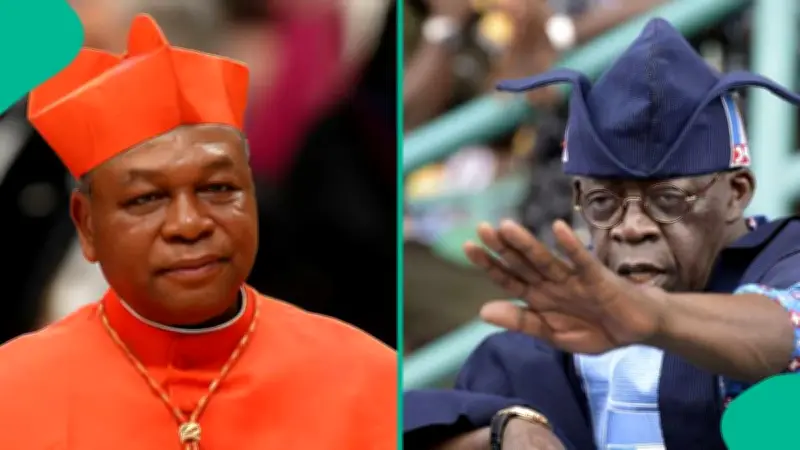
President Bola Tinubu directly dismissed the Catholic bishops' assessment of the country's condition, insisting that the economy was performing well despite their concerns, Cardinal John Onaiyekan has disclosed.
The Archbishop Emeritus of the Catholic Diocese of Abuja said Tinubu was visibly unhappy during a July 28 meeting at the State House with the Catholic Bishops' Conference of Nigeria (CBCN). In an interview on ARISE NEWS on July 31, Onaiyekan recounted how the President rejected the bishops' description of a nation in distress.
“When the nation is bleeding, you cannot expect a polite meeting with the Head of State. We had to let him know. And his reply is that the nation is not bleeding. We told him the economy is not helping our poor people; he told us the economy is doing fine. Frankly speaking, he told us quite clearly that he did not agree with us,” Onaiyekan said during the broadcast.
A Deliberate and Collective Message
Onaiyekan insisted that the CBCN's statement to the President was not hastily assembled. He revealed that the document went through multiple rounds of editing and was corrected until it represented the unified opinion of the entire conference, not merely the bishops present at the meeting.
“It was written, rewritten, and corrected. So it was not done at random, nor did we deliver it with levity,” he said.
The cardinal also moved to dismiss speculation that the bishops were motivated by political ambitions or alignment with any political party. “We have no ambitions to take Mr. Tinubu's job or anybody else's job. We are not politicians running for office. We are, first and foremost, religious leaders who feel we have a duty—not just to preach our religious doctrines, but also to address the lives of our people,” he explained.
President Surrounded by a Rosy Picture
Onaiyekan observed that Tinubu did not appear pleased during the encounter, suggesting that the President is rarely confronted with the realities many Nigerians face. He pointed to an entrenched culture around the presidency where advisers and associates feed the leader with overly optimistic assessments.
“There are so many people hanging around Mr. President, giving him a rosy picture of what the country is, which it is not,” Onaiyekan said. He added that one of the bishops' key concerns was the scarcity of honest voices within the government, noting that the delegation felt obligated to provide a truthful, albeit unwelcome, perspective.
INEC Credibility and Electoral Independence
Beyond the economy, Onaiyekan questioned the President's assertion that the Independent National Electoral Commission (INEC) operates independently. He argued that as long as the President appoints the commission's leadership, public trust in its neutrality will remain low.
“The chairman, all the members, and all the commissioners have been appointed by the President. Until we find a system where the membership of the electoral commission is put together not by Mr. President, but by a truly independent entity, that would remove the doubts,” he said.
Onaiyekan also touched on the upcoming governorship election in Osun State, revealing that the incumbent governor raised sharp complaints during the signing of the peace accord. The governor alleged that members of his party were being arrested and targeted, raising concerns about the fairness of the electoral process. The National Peace Committee, which oversees the accord, is now under scrutiny as the election approaches.
A Voice for the Voiceless
The cardinal expressed confidence that the bishops' message would not be ignored, describing the delegation as a conduit for many Nigerians who have no direct access to the President. “We have given voice to many people who could not reach him by themselves,” Onaiyekan said, adding that the church would continue to speak truthfully to power.
Previous Call From Christian Leaders
This is not the first time religious leaders have challenged Tinubu's administration. Earlier, the National Christian Elders Forum (NCEF) publicly urged the President to abandon any plans for a second-term bid in the 2027 elections. According to a communiqué dated July 9 and signed by its national chairman, Samuel Gani, the NCEF described the federal government's performance on security, economy, and welfare as “hugely sub-optimal.” The group argued that the government had failed to meet the expectations of ordinary Nigerians.




