
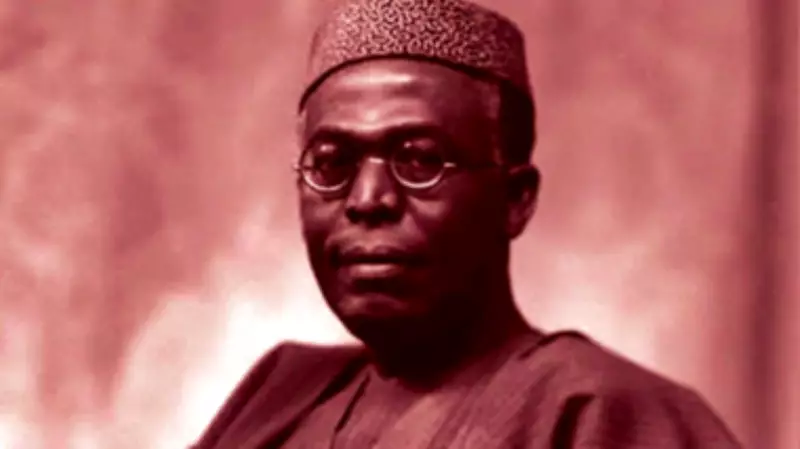
When pristine attitudes to the past have changed or are sullying before our very eyes, it is proper to romantically deal with them by brandishing a notable avatar or one who is the embodiment of the idyllic ideal – just to bolster our spirit or banish our doubts regarding a possible reincarnation. Obafemi Awolowo is undoubtedly an acceptable framework for almost any creative discussion of our socio-political fortunes that are yet trapped in memory waiting to be exhumed through sustained good governance or reasoned social democracy.
The published works of Awolowo are as relevant today as when he envisioned his apotheosis. The political rascality that is prevalent everywhere we turn today tends to give the fatal impression that we cannot hope to recapture the magic years of the Awo heritage. The yearly Obafemi Awolowo Foundation Memorial Lecture series offers us an opportunity to revalue or appreciate our common heritage in Awo. An increasing sense of social responsibility properly situates the annual lecture series even as new and vigorous standards of socio-political criticism are applied to Awo's advocacy each time.
The 2026 Lecture: Politics as Future-Making
The 2026 edition of the series finds its unique thematic appropriateness in its lecture topic: Politics as Future-Making: Awolowo and Leadership as Theory of Action. Awo is both a rigorous theorist and a man of progressive action – a rare combination even among thinkers. The place of Awo in Nigeria's history, or of his pragmatic, social-conscience politics, is surveyed every time in the light of our present-day dismal experience, and rightly so, even as they are eloquently presented. This is not to ignore the pervasive air of frivolity, perversion, the travesty of symbolism, or charlatanism that has become the ruling ethic in our political life and thought process.
Presidential Penn Compact Professor of the University of Pennsylvania, Wale Adebanwi, has in his paper laid the foundations for an actual analysis and interpretation, as well as causal explanation, of the idea of politics as the making of a future. He uses Chief Awolowo to buttress the argument for the ascription of the making of a secure or memorably good future during his life and times in politics and governance. Adebanwi has masterfully employed the reasoned methods of studying a subject matter as intricate or problematic as an imagined future, concerning himself with its peculiar setting, its environment, and its not-too-subtle external influences. He has sought to explain Awo and his future-making politics genre in terms of the Zeitgeist, some quintessential spirit of the time, some developing intellectual atmosphere, and even some rigidly-held opinion arising from ignorance or hubris.
Awo's Prophetic Warnings
The study of a man of genius, of morality, of intellectual and literary scholarship (in terms of his published output) like Awo can only be evaluated by reference to standards usually drawn from the history of some ethical system or code of behaviour. One is left wondering if Awo was of the same stock with us given today's general repudiation of the values of forthrightness, sincerity, doggedness, valour, and integrity. His character traits of accountability, work and ethics, merit, faith, human sympathy, etc. are legendary. Awo's intuitive clairvoyance made him the unofficial prophet of the nation. His prescient prognosis was like that of the Delphic oracle. Many of the problems bedevilling Nigeria today, Awo had prophetically foreseen and forewarned.
On the lack of foresight and the ineffectiveness of Nigeria's political leadership, Awolowo precociously foreshadowed today's misgovernance monstrosity: Our current leadership is totally bereft of new ideas, and utterly incapable of evolving or devising solutions for our problems. Our Government is a source of despair at home and a disgraceful laughing stock on the international scene. We are regarded as a chicken-hearted giant with jelly-like physique.
In an address titled God and Mammon Are Mutually Exclusive delivered at the retreat of the Methodist Church Nigeria on the 5th of September, 1970, Awo took a critical look at the basic problems of Nigeria: One of the phenomena in present-day Nigeria is a situation in which stark ignorance and extremity of poverty live side-by-side with high sophistication and dazzling affluence. How true, even today!
Regarding our penchant for crude material acquisition, Awo cautioned: Our animal passions and emotions have been brutally aroused and inflamed. A good number of our people, including youths and those in high places in our society, have developed callous cynicism and contempt for honesty and morality. Corruption is colossal and is practised on a scale never before attempted and with a skill and impunity never before imagined possible. Awo may have been referring to today's prevalent animus!
Espousing his social welfare convictions in 1982 in the wake of Nigeria's second Republic, Awo intoned: The good people of this country, the entire lot of them, are entitled to live in reasonable comfort. Nature herself commands that this should be so. Our natural and mineral resources are super abundant. Our human resources are just adequate for our purposes. Awo took a swipe at conscienceless and intellectually dull leaders who, in spite of their inappropriateness, hang on to power: And the agglomeration of obtuse, supine and unawakened minds that are responsible for this criminal neglect [of the people] want to continue – indeed, perpetuate themselves in office. How true of today's dim-witted occupiers of the office of public trust!
Awo's Diagnosis of Political Misconduct
Awo clinically identified five habitual misconducts and misbehaviours of those who wield political power: ethnic hegemony; rabid intolerance of opposition and criticism; complete absence of ideological goals; enthronement of mediocrity and the devaluation of merit; and arrogance of ignorance. How palpably true of today's mis-managers of the polity! Awo matter-of-factly concluded that it is certainly not possible for Nigeria to go forward into modernity at a fast pace manacled and chained with all the socio-politico-economic abnormalities mentioned above. He decried what he described as the complicity of the elite class and observed that it could not absolve itself from the crass misgovernance of those in power, as they actively partook, collaborated, or were complacently indifferent to the deteriorating Nigerian condition without any vehement opposition and struggle.
Adebanwi has re-posed Awo's angst by asking, in the present tense, a poignant question: How has it been impossible for there to emerge in Nigeria a sustainable good leadership in the light of Nigeria's evidently good human agency exemplified in such areas as medicine, law, civil advocacy, the arts (including literature), music, etc.? Why has the evidently-propitious human agency not been capable of weakening, if not neutralising, the strong and recalcitrant agency of bad national political leadership? The answer to Adebanwi's question is blowing in the wind but is located in the interstices of diverse or mutually-conflictive cultures, religious fundamentalism, up-beat sectarianism, and an iniquitous sense of political entitlement.
Awo's Faultline and Enduring Legacy
In the spirit of even-handed scholarship, Adebanwi identified Awo's faultline: his reliance on political practice as the sole or only instrument of social good. He calls it Awo's signal error. He describes it as Awo's near-fatal error, which nearly cost him his life but cost him his freedom for a number of years. It also cost him federal electoral victories. But it is the sworn belligerent commitment of rival elite formations to ensure that Awo's form of egalitarian rule would not be practically globalised nationally that is truly the cause of the defeat of Awo's democratic socialism advocacy; ruefully, it has become Nigeria's painful albatross or burden today.
We are however comforted by Longfellow's thoughtful admonition: Lives of great men all remind us and we can make our lives sublime. Awolowo has beamed the light and has actioned his socio-political philosophy of egalitarianism for all to see. He has left us a role to further the ideals of social democracy with its attendant incidents of social justice, rule of law, welfarism, equity, human dignity, happiness, and purposiveness in governance. To further Awo's ideological worldview, we must encourage the enlisting of persons who share the values of social democracy into the formation of a great and united political plank away from the antics or posturing of political dunderheads and their lamentably prebendal consorts. To immortal Awo, to live in the hearts of men is not to die.




