
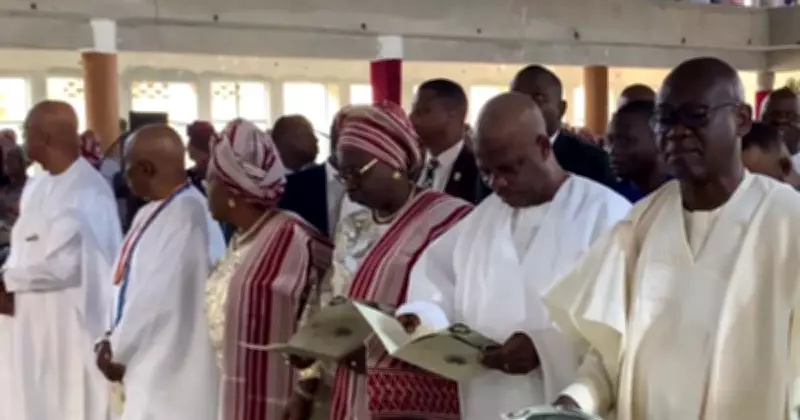
Seating Controversy at Onabanjo Burial: Independent Investigation Debunks Social Media Claims
In today's media landscape, where misinformation spreads rapidly, discerning truth from fiction becomes increasingly challenging. This challenge is particularly evident in the recent controversy surrounding the burial service of the late Mrs Lucia Onabanjo in Ijebu-Ode, Ogun State. Allegations of disrespect and protocol violations involving former Governor Senator Ibikunle Amosun and Secretary to the State Government Mr Tokunbo Talabi have dominated social media discussions, but a thorough independent examination reveals a different reality.
The Core of the Controversy
The central claim circulating online suggests that Senator Amosun was deliberately disrespected through improper seating arrangements during the solemn church service. According to sensational reports, this incident represented a power play by the current administration against political elders. However, video evidence and verified eyewitness accounts tell a more nuanced story that contradicts these inflammatory narratives.
From careful analysis of available footage, Senator Amosun was seated between the Deputy Governor of Ogun State and the seat designated for the Secretary to the State Government. Protocol for properly organized government functions dictates that the Speaker of the House of Assembly should occupy the position beside the Deputy Governor. The seat Senator Amosun occupied was, by established protocol and physical labeling, reserved specifically for the Speaker.
Verified Testimony Reveals Protocol Was Followed
Contrary to circulating claims, protocol officers had made appropriate arrangements for Senator Amosun's attendance. An aide to Senator Amosun, who arrived at the church as early as 8:14 a.m., well before the service commenced, provided verified testimony about the preparations. This aide met with protocol officers and specifically informed them that "SIA and his amiable wife will be coming." The protocol team responded promptly, labeling seats for Senator Amosun and his wife adjacent to those reserved for former Governor Gbenga Daniel.
The aide's account states clearly: "Those Governor's Protocol officers were not giving the lists of the personalities that will come, but after I got there as early as 8:14am, I met with them, told them 'SIA' and his amiable wife will be coming. So, they immediately attended to me by putting SIA and Madam's next to Gbenga Daniel's seat. So, when Omisore arrived, he saw the name of SIA and never sat there but it was Daniel who told him to sit beside SIA and Madam."
Diverging Political Narratives
This testimony establishes two crucial facts: first, that appropriate seats were indeed reserved for Senator Amosun and his wife, and second, that Senator Amosun made a conscious decision not to occupy those designated seats despite being aware of their location. The choice to sit elsewhere was entirely his own, not the result of any protocol failure or deliberate disrespect.
The investigation reveals a stark contrast between accounts from different political camps. Supporters of Senator Amosun have maintained relatively measured and factual statements, acknowledging that seats were provided, protocol was followed, and the incident represented at most a minor seating query. In contrast, narratives emerging from supporters of former Governor Gbenga Daniel have been sensational and inflammatory, designed to portray Governor Dapo Abiodun and his administration as disrespectful toward political elders.
The Danger of Political Propaganda
This episode highlights a disturbing trend in contemporary political discourse where sympathy for particular causes mutates into wholesale fabrication of events. What should have been recognized as a minor seating adjustment at a solemn occasion has been transformed into a dramatic narrative of disrespect and power struggle. This transformation serves political agendas rather than truth-seeking journalism.
The investigation demonstrates that we have reached a point where events witnessed by hundreds of people and recorded on video can still be reported in ways that bear little resemblance to reality. The reason is straightforward: certain individuals prioritize narratives that serve political ends over factual accuracy. They are not interested in truth but in advancing particular agendas through manufactured controversy.
Call for Discernment in Media Consumption
For citizens navigating this media landscape, applying critical discernment becomes essential. When encountering conflicting accounts of events, several questions should guide evaluation: Which account aligns with available video evidence? Which relies on unnamed sources and dramatic language? Which acknowledges facts even when inconvenient to preferred narratives?
The burial service of Mrs Lucia Onabanjo was a solemn occasion meant to honor a respected community member. The seating arrangement issue that emerged was minor, quickly resolved, and should not have overshadowed the event's primary purpose. Everything beyond this basic fact represents political noise that distracts from substantive issues facing Ogun State and Nigeria as a whole.
Truth matters in public discourse because when we allow lies to stand unchallenged, we all lose something precious: the shared understanding of reality necessary for meaningful dialogue and progress. This independent investigation serves as a reminder that in an age of rampant misinformation, verifying claims through evidence and credible testimony remains our most reliable path to truth.




