
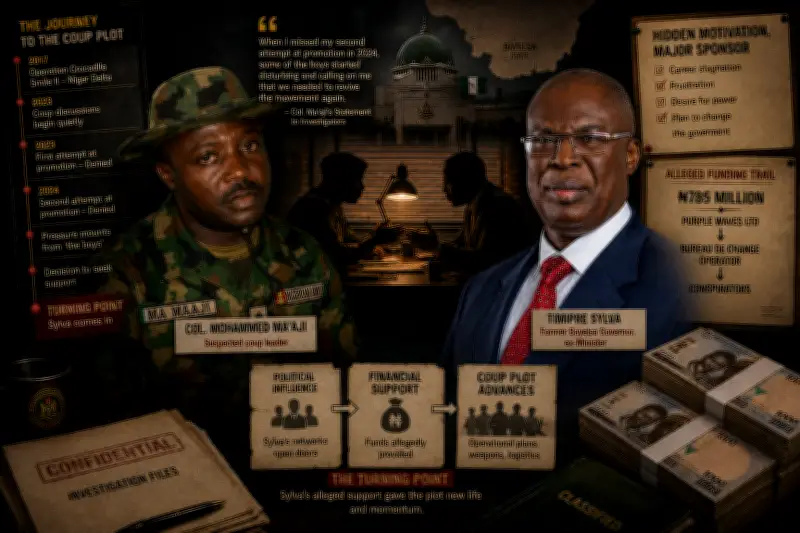
Fresh revelations from over 7,400 pages of investigation documents have exposed the exact circumstances that turned former Bayelsa State Governor Timipre Sylva into the alleged chief financier of the failed plot to unseat President Bola Tinubu. The sealed investigative files, obtained and reviewed by Premium Times, contain witness statements, handwritten confessions, and records of secret conversations that trace the evolution of the coup conspiracy from a struggling idea to a fully funded plan. Among the exhibits are the detailed accounts of Colonel Mohammed Ma’aji, the suspected ringleader, which place Mr Sylva at the heart of the plot’s financing.
How the documents tie Sylva to the plot
Mr Sylva, a former oil minister and a member of the ruling All Progressives Congress (APC), has not been formally charged as an individual. He is believed to be outside Nigeria. However, five of his former aides and domestic workers are facing charges in Abuja for allegedly concealing information about his whereabouts. The government has also obtained an interim forfeiture order against nine assets linked to him, signalling a widening legal net.
Investigators said Mr Sylva contributed the largest share of N785 million allegedly raised for the coup. The funds were purportedly moved through Purple Waves Limited, an Abuja-based construction company, and then via a bureau de change operator before reaching the intended recipients. The company’s secretary, John Ebokpo, has been interrogated by security operatives. But new discoveries provide the missing details leading up to those transfers, revealing how the former governor was drawn into the conspiracy.
Ma’aji’s account of Sylva’s recruitment
Colonel Ma’aji, a Nigerian Army officer, traced his relationship with Mr Sylva to his days as a captain, when he was deployed to the oil-rich Niger Delta. Their paths likely crossed during military operations such as Operation Crocodile Smile II in 2017, which addressed militancy and oil theft in the region. Over the years, the two men moved in overlapping circles of politics, oil, and security, building trust that would later prove decisive.
Ma’aji, who failed promotion examinations in 2023 and 2024, cited career stagnation as part of his motivation for the coup. In his handwritten statements, he said he approached Mr Sylva for financial support only after much pressure from his co-conspirators. “In terms of logistics support, also recently after much pressure from some members, I had to approach Chief Timipire Sylva for financial support,” he wrote.
From refusal to commitment
Initially, Mr Sylva was dismissive. Ma’aji recorded his response: “Col., please I don’t want to hear about this.” In another part of the statement, he wrote that Mr Sylva “told me that he does not want to be involved in any military issues.” But weeks later, the former governor called back. Ma’aji said Mr Sylva asked about the details and the chances of success, and whether the group had secured funding. When Ma’aji said no, Mr Sylva revealed he had changed his mind after deep reflection.
“He said he has thought deeply about our movement and the situation of the country and it is only military intervention that could save the country from the precarious situation,” the colonel stated. Mr Sylva allegedly confessed that politicians had failed Nigerians and doubted that the current crop of leaders had the patriotic zeal to fix the nation. He also said he had sent all his children abroad because of the unfavourable conditions in Nigeria.
Sylva’s request for secrecy
While agreeing to provide funds, Mr Sylva insisted on staying untraceable. Ma’aji said: “He then said he would not want to send money to my personal account because he doesn’t want anything traced to him.” The colonel suggested using his friend, a bureau de change operator named Alhaji Aminu, to receive the funds. Sylva approved. Ma’aji later learned from Alhaji Aminu that he had received over N400 million by the time of the arrest. Investigators believe the total traced to Mr Sylva eventually reached N785 million.
The money was disbursed for different purposes, which Ma’aji said he could not mention. The detailed financial trail is expected to be revealed in subsequent parts of this reporting series.
Denial and ongoing legal actions
Mr Sylva has denied any involvement. In a press statement issued in October last year, his spokesperson, Julius Bokoru, dismissed the allegations as untrue. The statement acknowledged that individuals believed to be operatives of the Defence Headquarters raided Mr Sylva’s residence. It described him as “a thoroughbred democrat, whose entire political journey has been defined by his faith in democratic processes and institutions.”
The statement also affirmed Mr Sylva’s loyalty to President Tinubu, recalling how he mobilised the entire Bayelsa APC structure to endorse the president. It characterised the coup allegations as “nothing more than the handiwork of desperate and narcissistic politicians, already consumed by ambitions for 2027.”
Despite the denial, the government continues to pursue legal avenues. Prosecution of the five associates for concealing Mr Sylva’s whereabouts is ongoing at the Federal High Court in Abuja, while military personnel linked to the plot face trial at a General Court Martial. The nine forfeited assets remain under court order as investigators press ahead.




