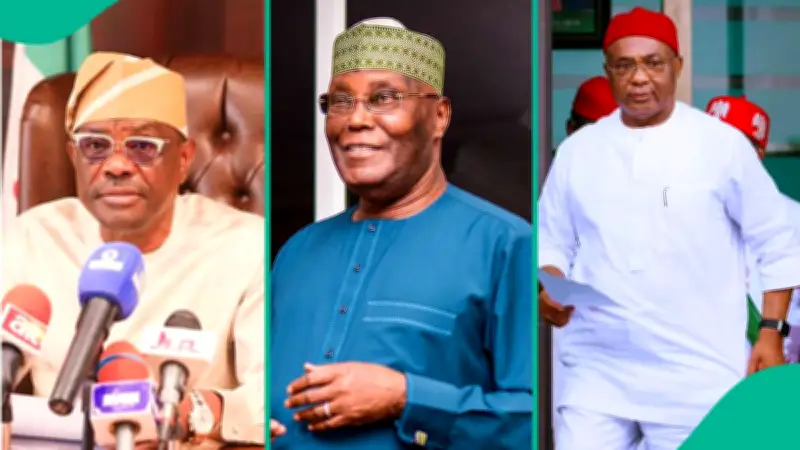
The public dispute between FCT Minister Nyesom Wike and a bloc of APC governors, led by Imo State Governor Hope Uzodimma, is being interpreted by political observers as the most significant fracture in President Bola Tinubu's political coalition ahead of the 2027 general elections.
Two Conflicting Strategies for 2027
Dare Glintstone Akinniyi, a political and social communication strategist and spokesperson for the New Democratic Frontiers, stated that the clash is not merely a personality conflict. In an exclusive interview with Legit.ng, Akinniyi explained that the confrontation reflects two fundamentally different visions for securing a Tinubu victory in 2027.
According to Akinniyi, Wike's approach is built on presidential-only loyalty. By maintaining his PDP structure in Rivers State and beyond while delivering votes for Tinubu at the top of the ballot, Wike retains personal leverage. When Wike described APC governors as "politically lazy," Akinniyi said he was telling them to mobilize at polling units rather than rely on Tinubu's name to carry their own local races.

The APC governors, however, view the situation differently. Their concern is that a minister who remains aligned with the PDP, and who is building what many describe as a parallel political structure, cannot genuinely be considered loyal to the APC. Akinniyi noted that their fear is practical: if voters are encouraged to back Tinubu for president but reject APC candidates for governor and senate, many of them will lose their seats. This risk is felt most sharply in Rivers, Kwara, Gombe, and Cross River.
Who Benefits from the Fight
Akinniyi argues that the biggest beneficiary of this internal war is former Vice President Atiku Abubakar and the African Democratic Congress (ADC). The ADC's central argument in 2027 is that the APC is fragmenting. A sitting federal minister calling APC governors "politically lazy" on live television, while those same governors pass a vote of no confidence in his coalition, provides the opposition with the evidence it needs to make that case credible.
The strategist also highlighted the risk of ticket-splitting. If Wike's Rainbow Coalition, which draws from APC, PDP, Labour, and Action Alliance members, campaigns on a message of voting Tinubu for president while backing other parties down the ballot, it could split votes. Akinniyi said Atiku will benefit directly in the North Central, South-South, and South East regions. A fragmented APC base in those regions requires less work from the ADC at the grassroots.
Akinniyi referenced Wike's own statement that Atiku failed to reach 10% of the vote in Rivers State in 2023 and vowed the same outcome in 2027. However, he noted that the Rainbow Coalition in Rivers is itself divided, with no agreement yet on a governorship candidate between Chinda and a riverine alternative. Akinniyi added that candidates such as Gabriel Pidomson for the ADC and Dumo Lulu-Briggs for the NDC could benefit from the voters both Wike and Governor Siminalayi Fubara are leaving behind.
Tinubu's Intervention and Broader Impact
Beyond Rivers, Akinniyi warned that every day President Tinubu spends brokering peace between his minister and his governors is a day Atiku can spend campaigning freely in the Northwest and Northeast, where the former vice president has already been intensifying his ground efforts.
Meanwhile, Legit.ng also reported that President Bola Tinubu was expected to step in and broker peace between Wike and APC governors over the 2027 election dispute. A senior presidential aide said the intervention, which could happen abroad, was linked to concerns the rift might damage Tinubu's re-election chances. South East APC leaders and a former House Minority Leader had both publicly condemned Wike's comments and his Rainbow Coalition push.