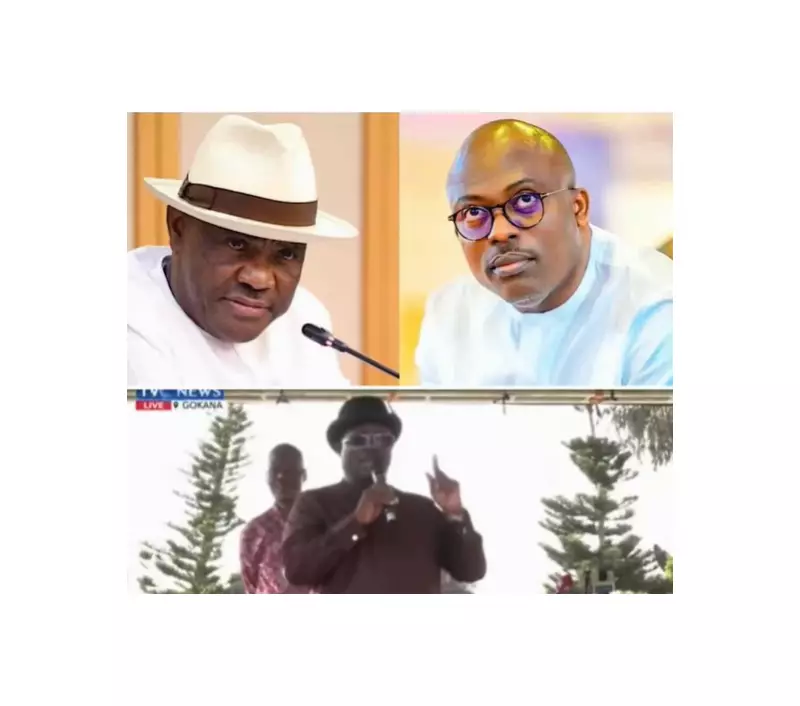
A senior official of the All Progressives Congress (APC) has issued a stark political declaration, stating that Rivers State Governor, Sir Siminalayi Fubara, must seek the approval of the Federal Capital Territory (FCT) Minister, Nyesom Wike, to achieve any electoral success in the state.
A Stark Declaration in Gokana
The statement was made publicly by Hon. Victor Giadom, the National Vice Chairman of the APC for the South-South region. Giadom delivered his message on Tuesday, December 30, during a special event known as Wike's Thank You Visit to the people of Gokana Local Government Area in Rivers State.
In his address, Giadom firmly positioned Wike as the undisputed political leader in the area. He described the former governor as a "dependable leader" within the complex landscape of Rivers State politics and offered him strong assurances regarding his influence.
Gokana Declared a 'No-Go Area'
Giadom's words left little room for interpretation regarding the current power dynamics. Speaking on behalf of his associates, he guaranteed that the people of Gokana were firmly aligned with Wike and President Bola Tinubu.
"I guarantee, on behalf of my brothers, that the Gokana people are for Wike and Tinubu and nobody will challenge Wike's influence in Gokana," Giadom asserted. He went further to label the local government area as politically exclusive, stating, "Gokana is a 'no go area' for anybody, be it the so-called Governor of Rivers state. For him to win anything in Gokana, he must pass through Wike."
The Backdrop of a Political Cold War
This public pronouncement is the latest development in the ongoing and increasingly visible rift between Minister Nyesom Wike and his political protégé, Governor Siminalayi Fubara. The relationship between the two powerful figures has been frosty since Wike defected to the ruling APC and subsequently asserted his position as the leader of the party in Rivers State.
The public challenge from a high-ranking APC chieftain directly to a sitting governor from a different party underscores the intense and personal nature of the political battle currently shaping the state's future. It signals that the conflict has moved beyond internal party squabbles into a direct confrontation for territorial control and political legitimacy.
Analysts suggest that such statements are likely to deepen the political crisis in Rivers State, forcing stakeholders, party members, and the electorate to choose sides in a struggle that shows no immediate signs of abating.