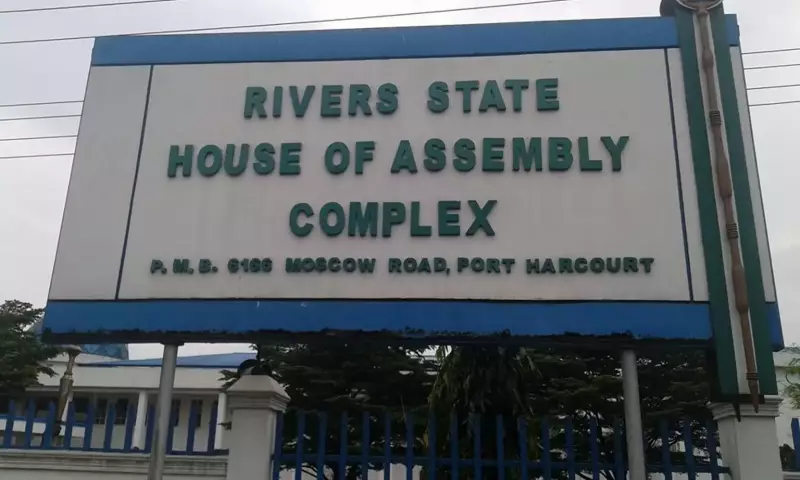
The political temperature in Rivers State has soared to a new high following a controversial decision by the state's House of Assembly. On Thursday morning, during a plenary session, the Assembly initiated impeachment proceedings against Governor Siminalayi Fubara and his deputy, Professor Ngozi Odu. The lawmakers cited allegations of gross misconduct, including a failure to present a mid-term expenditure framework and irregularities in budgetary processes.
Deepening Divides and Competing Narratives
The move has not only intensified the state's political tensions but has also laid bare the profound fractures within its landscape. Public discourse is now dominated by sharp accusations, counter-accusations, and urgent calls for restraint from various quarters.
Reactions among residents are sharply divided. Some view the impeachment as a desperate "last card" for the 26 legislators, whose influence they believe has waned since Governor Fubara defected to the All Progressives Congress (APC) and aligned with President Bola Tinubu. Conversely, others interpret the development as a sign that the governor's tenure may be nearing its end, arguing that once such proceedings begin, political survival becomes highly uncertain.
Public affairs analyst Eme Kingsley framed the crisis within the context of national politics. He asserted that President Tinubu is fully aware of the unfolding events in Rivers State. Kingsley questioned the governor's sincerity regarding past peace agreements brokered by the President and dismissed the idea that the Assembly lacks access to the Presidency.
"Their leader, Nyesom Wike, has unrestricted access to the President. Just a few days ago, two of his allies were given presidential appointments," Kingsley noted. He further argued that judicial rulings have empowered the Assembly, claiming the Supreme Court had previously indicted the governor for financial misconduct, such as spending without appropriation.
Fierce Opposition from Ethnic and Political Blocs
The impeachment move has triggered significant pushback. The Eastern Zone of the Ijaw National Congress (INC) and the Ijaw Youth Council (IYC) held a joint press conference in Port Harcourt to voice their strong opposition. Led by figures like INC Chairman Abel Peterside and IYC Chairman Prince Datolu Sukubo, the groups accused the Minister of the Federal Capital Territory, Nyesom Wike, of escalating hostilities.
They warned that his actions pose a grave threat to public peace and democratic stability in Rivers State. The groups criticized the undermining of the June 26, 2025 peace accord brokered by President Tinubu and condemned alleged demands for the removal of senior state officials like SSG Dr. Tammy Danagogo and Chief of Staff Edison Ehie as an unconstitutional encroachment on the governor's powers.
In a surprising political twist, the Rivers State chapter of the APC, led by Emeka Beke, also rejected the impeachment. Party spokesperson Darlington Nwauju stated it would be "totally untenable" to stay silent while internal PDP crises destabilize an APC-led government. Nwauju questioned the necessity of the impeachment, pointing to an existing budget approved under emergency rule that runs until August 2026.
Civil Society Warns of Constitutional Breach and Instability
Adding to the chorus of dissent, the Human Rights Writers Association of Nigeria (HURIWA) condemned the plot as "reckless, unconstitutional and morally indefensible." In a statement by National Coordinator Comrade Emmanuel Onwubiko, HURIWA accused lawmakers of acting as proxies and called for President Tinubu's urgent intervention.
Similarly, the Rivers Peace Initiative, through its Convener Obinna Ebogidi, warned that the impeachment notice represents a dangerous escalation capable of plunging the state back into instability. The group emphasized that impeachment is a grave constitutional tool, not an instrument for political pressure, and called for immediate de-escalation and dialogue.
As reactions continue to flood in, Rivers State finds itself entangled in a complex web of competing forces: legislative authority, executive survival, ethnic mobilization, party loyalty, and federal influence. Analysts agree that without credible mediation and urgent restraint, the state risks a prolonged period of political uncertainty, with governance, development, and public confidence hanging in the balance.