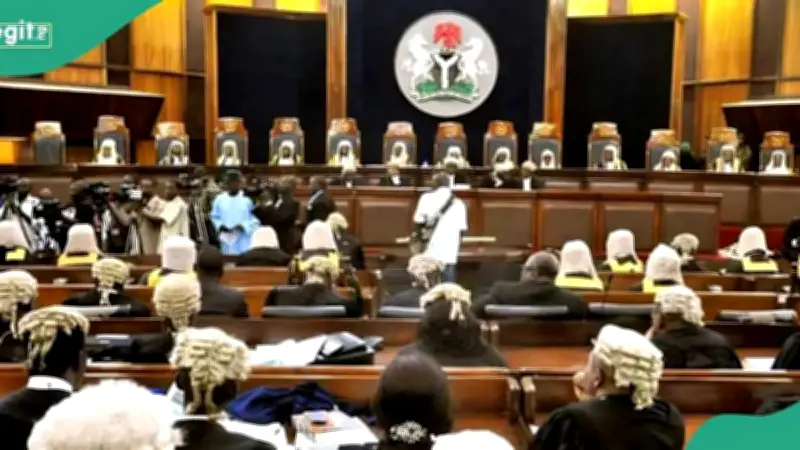
Nigeria's political landscape is set for a wave of legal disputes over party primaries ahead of the 2027 general elections, following a unanimous Supreme Court judgment that restored key provisions of the Electoral Act 2026. The ruling, delivered on Thursday, September 24, 2026, by a seven-member panel led by Justice Adamu Jauro, reinstated Sections 77(5), 77(6), 77(7) and 84(2) of the Act, which govern party membership registers and candidate nominations. This decision reverses an earlier July 16 ruling by the Court of Appeal that had declared those provisions unconstitutional, according to a report by The Punch published on Sunday, September 27, 2026.
Supreme Court Restores Electoral Act Provisions
The Supreme Court heard INEC's appeal on September 16, 2026, after a Federal High Court dismissed a challenge brought by the Zenith Labour Party. The restored provisions require political parties to submit membership registers to the Independent National Electoral Commission (INEC) within a set period and to use those registers for their primaries. Section 84(2) specifically addresses the use of direct primaries or consensus in nominating candidates. The judgment does not automatically disqualify any candidate, but it has drawn scrutiny to several high-profile politicians whose nomination processes may now face legal challenges.
Among those under potential scrutiny are former Inspector-General of Police Mohammed Adamu, who emerged as the Social Democratic Party's governorship candidate in Nasarawa State through a substitution primary, and former House of Representatives Minority Leader Kingsley Chinda, who became the All Progressives Congress (APC) governorship candidate in Rivers State. Senator Saliu Mustapha, who defected from the APC to the Peoples Democratic Party (PDP) before picking the PDP's senatorial ticket for Kwara Central, is also in the spotlight.
Pantami's Candidacy Nullified by Court
Former Minister of Communications and Digital Economy Isa Pantami faces a separate legal battle. A Federal High Court in Gombe nullified the PDP primary that produced him on September 24, 2026, after he emerged through voice affirmation following his defection from the APC to the PDP. The challenge was filed by fellow aspirant Usman Garry. The court ordered the PDP to conduct a fresh primary within 30 days, and the party has fixed September 29 for the exercise. PDP's Public Relations Officer in the state, Abdulkadir Dukku, said all eligible delegates had been directed to gather at their ward areas and vote for the aspirant of their choice.
Senator Olubiyi Fadeyi, representing Osun East, also dismissed claims that the ruling had ended his re-election bid, saying his emergence as the PDP's candidate for Osun Central Senatorial District in 2027 was done strictly in line with the Constitution and the Electoral Act.
Legal Experts Divided on Impact
Senior lawyers are divided on whether the judgment could affect primaries already concluded. Senior Advocate Salman Jawondo told the press that the judgment carried no automatic effect on concluded nominations. "It does not affect any nomination at all. INEC needs a fresh court pronouncement to delist them. Some people must complain before INEC can act," he said. He added that any legal challenge must be filed within 14 days of the event being contested and only by a person with the appropriate legal standing.
Fellow Senior Advocate Bolaji Ayorinde said the ruling simply restated the constitutional framework and created no fresh ground for disqualifying candidates. He called on INEC to implement the judgment without disenfranchising candidates or parties. NBA Ikirun Branch Chairman Abdulkareem Azeez said the court made no factual findings on the membership status, defection timelines or primary conduct of any individual candidate, and that disputed cases would ultimately require separate court proceedings to resolve.
INEC did not provide an official response before press time. In a related development, a federal high court in Yenagoa, Bayelsa State, ruled that former President Goodluck Jonathan was eligible to contest in the 2027 election. The decision, delivered on May 27, 2022, by Justice Isa Dashen, held that a section of the Nigerian Constitution barring individuals sworn in twice from contesting for the presidency cannot be applied revisionally to Jonathan's situation.