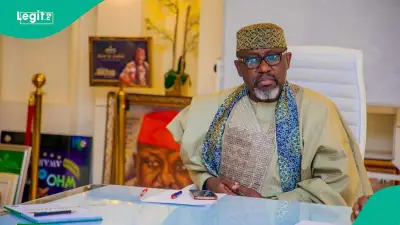
In a definitive statement on the power dynamics within Nigeria's ruling party, the National Chairman of the All Progressives Congress (APC), Professor Nentawe Yilwatda, has firmly rejected the notion that state governors wield control over the party's affairs. Yilwatda emphasized that the APC operates on a strict national institutional framework, with all major decisions coordinated from its central headquarters.
National Structure Overrides Individual Influence
Yilwatda made these clarifications during an appearance on the Sunset programme broadcast by Jay FM in Jos, Plateau State, on January 7, 2026. He detailed that the party's activities across states and local governments are not autonomous but are meticulously planned and approved at the national level. This system, he argued, is designed to maintain uniformity, prevent personal interests from dictating party direction, and ensure collective ownership.
"Across the country, nobody can take any section of the party. For anything you are going to do at the state level, it is planned at the National level. It is not planned at the state level. This is the APC structure and that is how we work," the chairman stated.
He further stressed that the APC functions on institutional order, deliberately moving away from sentiments or personal influence. "We work with structure. We don't work with sentiments and emotions. Nobody has control over the party, even myself. No local government chairman has control over APC. No governor has control over APC. No senator or individual has control over APC," Yilwatda declared.
Deliberate Absence of a Board of Trustees
Another significant point addressed by the APC leader was the party's conscious decision not to establish a Board of Trustees, a common feature in other Nigerian political organizations. Yilwatda explained that this model was adopted to circumvent internal power struggles and concentration of influence within a small, powerful group.
He posited that in the APC, the members and supporters themselves are the trustees. "That was why APC doesn't have a board of trustees. APC is owned by the people. People are the trustees of APC," he said. This approach, according to him, fosters accountability and ensures the party remains a collective enterprise rather than being held by a few individuals. He expressed confidence that this structural choice continues to bolster unity and stability within the party's ranks.
Context and Recent Party Movement
The chairman's remarks come at a time of ongoing political realignments in the country. In a related development, former member of the House of Representatives, Dachung Bagos, recently defected from the Peoples Democratic Party (PDP) to the APC. Bagos declared his support for President Bola Ahmed Tinubu and Plateau State Governor Caleb Mutfwang, citing ongoing reforms aimed at tackling insecurity and strengthening the economy.
Yilwatda's firm delineation of the APC's power structure serves to reinforce the party's official narrative of centralized, institutional control, directly challenging perceptions of gubernatorial dominance within its fold.