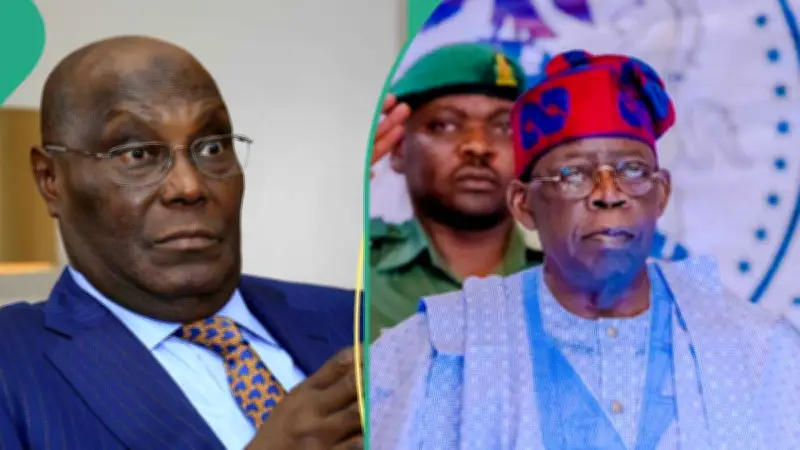
Atiku Abubakar, the presidential candidate of the African Democratic Congress (ADC), has declared that Nigeria will never achieve prosperity through borrowing, importing goods, or raising taxes. He argued that the country's only viable path forward is to produce its own food, manufacture its own goods, and build an export-driven economy.
Atiku Blames Decades of Policy Choices for Economic Suffering
The former vice president asserted that the economic suffering many Nigerians now face is not simply a product of global conditions but the direct result of decades of policy choices that favoured consumption over production. Atiku made the remarks in a statement released on Monday, July 20, 2026, by his Senior Special Assistant on Public Communication, Phrank Shaibu.
“For too long, we have celebrated importation while neglecting production. We import food that should be grown in our fields, goods that should be manufactured in our factories, and even raw materials that ought to be processed by Nigerian hands. No nation has ever become prosperous by exporting jobs and importing poverty,” Atiku said.
Food Inflation and Factory Decline: The Evidence
To support his position, Atiku pointed to current economic data showing that food inflation stood at 17.52 per cent nationally, while Kogi State recorded 53.02 per cent and Niger State 43.83 per cent. He also noted that Nigerian manufacturers spent ₦3.53 trillion importing raw materials in just six months. According to Atiku, the falling manufacturing tax contributions indicate that factory output across the country is shrinking.
“A nation cannot build prosperity when its factories are falling silent. We are exporting jobs, importing inflation, weakening the naira, and mortgaging our future,” he warned.
Atiku’s Vision for a Production-Driven Economy
Atiku highlighted that cocoa from Ondo State, rice from Kebbi, yam from Benue, tomatoes processed in Kano, pharmaceuticals from Aba, leather goods from Kano, and machinery assembled in Nnewi all represent the kind of production activity that creates jobs and strengthens the currency. He recalled that economic reforms carried out during the Obasanjo-Atiku administration between 1999 and 2007 opened key sectors to private investment and delivered one of Nigeria's strongest periods of growth. Atiku said a future ADC government would build on that legacy.
Proposed Measures for Economic Transformation
Among the measures he proposed are cutting import duties on industrial machinery not made locally, providing long-term affordable credit to farmers and manufacturers, stabilising the naira, investing in power, roads, rail, irrigation and storage, and reforming the tax system to reward production rather than penalise it. The ADC flagbearer also said restoring security to farming communities would be a priority, arguing that food security starts with farm security.
“Factories cannot thrive where borrowing is prohibitive, energy is unaffordable, the currency is unstable, and consumers are too poor to buy locally made goods. Our mission is simple: Produce in Nigeria. Employ Nigerians. Consume Nigerian products. Export Nigerian excellence,” Atiku stated.
Atiku Slams Tinubu Over 2026 Budget
In a related development, Atiku described the 2026 Federal Budget as the most brazen assault on transparency in Nigeria's democratic history. He noted that the Service-Wide Vote in the 2026 Appropriation Act ballooned from ₦638 billion to ₦12.8 trillion, a near 1,918 per cent increase in one year. Atiku demanded the National Assembly launch a line-by-line investigation into the allocations and asked who the workers earning ₦2.19 trillion in personnel costs are.
Fresh Scandal in Tinubu’s Administration
Atiku also described the Tinubu administration as one of Nigeria's most fiscally reckless governments following revelations of ₦210 billion in duplicated budget allocations. He linked the budget scandal to Nigeria's poor performance on nearly 90 per cent of global prosperity indicators. Atiku demanded a forensic review of the 2026 Appropriation Act and called on anti-corruption agencies to independently scrutinise the federal budget.