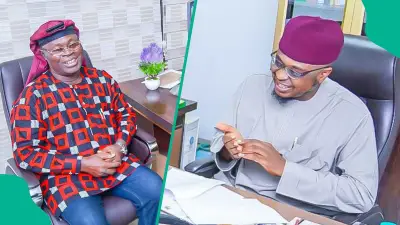
Afenifere National Publicity Secretary, Prince Justice Faloye, has strongly criticized Nigeria's political class for sidelining Chapter II of the Nigerian Constitution, titled 'Fundamental Objectives and Directive Principles of State Policy.' He asserts that this chapter contains the essential blueprint for a functioning nation.
Politicians Prioritize Power Over Social Contract
Faloye, who also serves as president of ASHE Foundation, stated that since 1999, politicians have implemented only the parts of the Constitution that grant them power while abandoning the social contract embedded in Chapter II. Instead of delivering security, welfare, free education, healthcare, and a self-reliant economy, leaders have promoted ethnic, religious, and personality-cult politics to distract citizens.
Inability to Sue Government Over Chapter II
He lamented that citizens cannot sue the government for failing to implement Chapter II. Faloye accused successive administrations of embracing neoliberal policies imposed by foreign interests, tracing this shift to Milton Friedman's neoclassical theories and IMF/World Bank conditionalities after the 1973 oil crisis.
He cited historic education subsidy removal, suppression of students and labor, coups, and marginalization of pro-people politicians as evidence of this sabotage. The Afenifere spokesman blamed neoliberal reforms for undermining projects and worsening inequality, noting that President Tinubu's post-2023 subsidy removal and devaluation followed these prescriptions, halving GDP and raising poverty from 38% to 63%.
SDP Alignment with Chapter II
Faloye welcomed the Social Democratic Party (SDP) alignment with Chapter II of the Constitution and highlighted SDP presidential candidate Prince Adewole Adebayo's 'War Against Poverty' program, which he described as consistent with the chapter. According to Faloye, the plan includes a Modern Monetary Theory-financed public works program managed by the Nigerian Defence Industries Corporation; construction of 7,000 housing units daily to provide 'a roof over every head,' raising real estate's GDP share from 5% to 20%; and building 10 kilometers of railway per day to drive industrialization and living wages.
Structural Poverty and Governance Reforms
Faloye argued that these policies would tackle Nigeria's structural poverty, low wages in informal sectors, agricultural waste, and weak manufacturing. He noted that SDP proposals for restructuring ethnic groupings and placing the Nigerian Traditional Council in oversight roles like INEC, among other institutional formations, will bring positive changes to governance in the country.
The ASHE president concluded that until Chapter II of the Federal Constitution of Nigeria is implemented and politics becomes ideological rather than ethnic or personality-driven, Nigeria cannot function as a proper country.