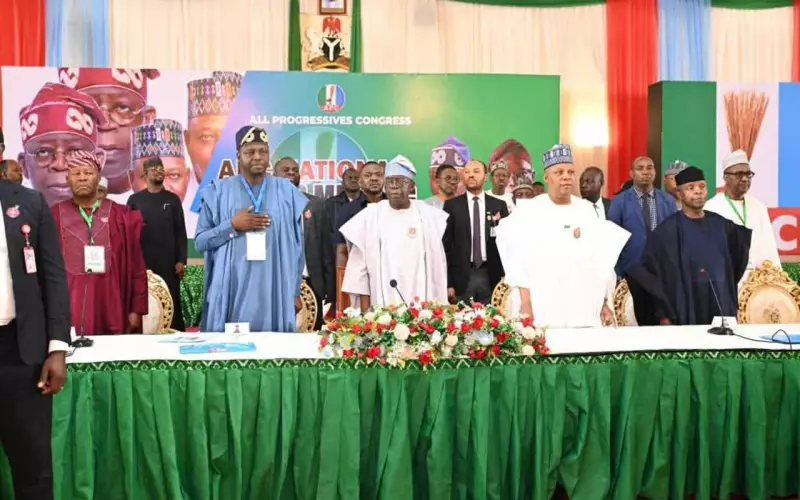
A significant wave of political defections across Nigeria is dramatically reshaping the nation's political landscape, strengthening the ruling All Progressives Congress (APC) and raising critical questions about the opposition's viability ahead of the 2027 general elections.
In a series of coordinated moves, federal lawmakers, party executives, and influential political blocs have abandoned their former parties, citing internal crises and a desire for stability. This mass migration signals an accelerating consolidation of power by the APC, while opposition parties like the Peoples Democratic Party (PDP) and Labour Party (LP) grapple with deepening fractures.
Major Defections Bolster APC's Ranks
The most immediate impact was felt on the floor of the House of Representatives on December 18, 2025, when Speaker Abbas Tajudeen announced the defection of four lawmakers from Rivers State to the APC.
The defectors include three former PDP members: Awaji Inombek Abiante (Andoni–Opobo/Nkoro), Boma Goodhead (Akuku-Toru/Asari-Toru), and Emerengwa Boniface (Emoha/Ikwerre). They were joined by Manuchim Umezuruike (Port Harcourt I), who left the Labour Party. In their letters, the legislators attributed their decision to prolonged and unresolved internal crises within their former political homes.
This development follows the high-profile defection of Rivers State Governor, Siminalayi Fubara, to the APC. Governor Fubara announced his move at a stakeholders' meeting in Port Harcourt, stating that full political alignment was necessary to effectively support President Bola Tinubu's administration. He joins a growing list of governors who have left the PDP, including those from Delta, Akwa Ibom, Enugu, and Bayelsa states.
Recall that President Tinubu had declared a state of emergency in Rivers State on March 18, 2025, suspending Governor Fubara, his deputy, and the state assembly for six months to address a governance breakdown. Following his reinstatement, Fubara pledged to prioritise peace and political stability.
Opposition Realignments and Strategic Moves
While the APC gained ground, the opposition space also witnessed significant realignment. The senator representing the Federal Capital Territory (FCT), Mrs. Ireti Heebah Kingibe, formally defected from the Labour Party to the African Democratic Congress (ADC).
Kingibe received her ADC membership card at the party's national headquarters in Wuse, Abuja, ending months of speculation about her political future. Analysts note that her exit from the LP was delayed by the party's internal crises and leadership uncertainty. As the ADC's only serving senator, her move is seen as a major boost for the party's national profile and influence in the FCT.
Through her aides, Kingibe stated her decision was driven by a commitment to inclusive governance, accountability, and a structured opposition—values she believes are firmly embedded in the ADC.
APC Consolidates in Northwest Strongholds
The ruling party's expansion continued in the Northwest. In Sokoto State, political loyalists of former Governor Attahiru Dalhatu Bafarawa, including the PDP's 2023 deputy governorship candidate, Sagir Bafarawa, defected to the APC.
The chairman of the movement, Prof. Muhammad Hamza Maishanu Yabo, said the collective decision followed months of consultation. The group resolved to support Governor Ahmed Aliyu's administration and work towards his re-election in 2027, citing his delivery of democracy dividends and respectful treatment of their principal.
Former Governor Bafarawa clarified that he has retired from active partisan politics and now serves as an elder statesman. He stated he would not oppose his supporters' choice to join the APC and wished them well.
Similarly, in Zamfara State, the APC recorded a gain in Maradun Local Council as the entire PDP executive committee members defected. The move followed a crucial meeting with the Minister of State for Defence, Bello Muhammad Matawalle, who hails from Maradun. The defectors pledged loyalty to Matawalle and his ally, Senator Abdulaziz Yari, vowing to mobilise support for the APC in the area.
Experts Link Leadership Crisis to Electoral Fraud
Amidst the political shuffling, lawmakers and governance experts gathered in Abuja to address the root causes of Nigeria's leadership failures. At the public unveiling of a new book, Leadership 365 by Prof. Linus Okorie, speakers presented a stark diagnosis.
Senator Ikechukwu Obiora argued that Nigeria's inability to produce accountable leadership is directly linked to decades of manipulated elections and compromised institutions. "When leaders rig their way into office, they do not feel accountable to the people," he stated. He rejected the notion that moral decay among youths is the primary problem, instead blaming the impunity of political elites for shaping a corrupt culture.
Obiora cautioned against over-reliance on technology to solve electoral malpractice, stressing that digital tools are ineffective in the hands of compromised institutions. He called for constitutional reforms to guarantee a genuinely independent electoral management body.
Senator Osita Izunasor emphasized that leadership is defined by service, not status, and called for experienced leaders to mentor younger Nigerians. Author Prof. Linus Okorie explained that his book was designed as a daily manual for ethical leadership development, advocating for its adoption in schools and universities.
The consensus was clear: Nigeria's recovery hinges on credible elections, strong institutions, and the daily practice of ethical, service-driven leadership. As the 2027 elections draw closer, the current defections may be just the beginning of a more profound political reordering.