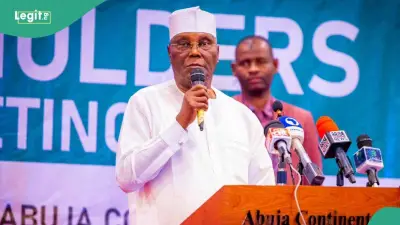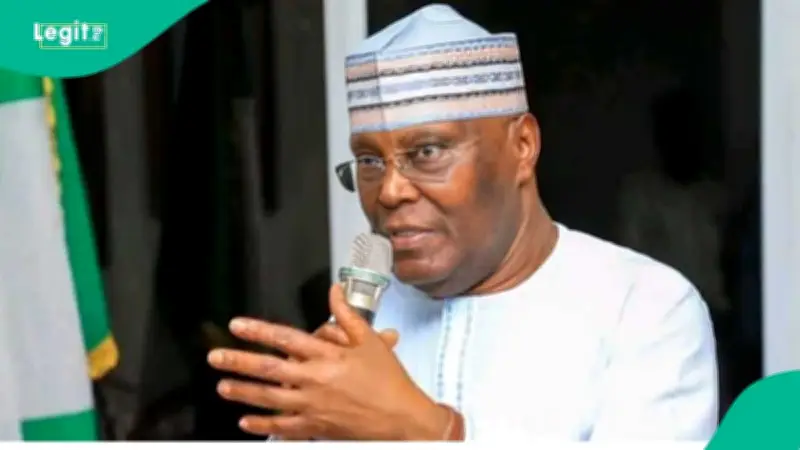
Former Vice President Atiku Abubakar has fiercely condemned the National Economic Council's (NEC) approval of a $4.5 billion refinancing deal for the Nigerian National Petroleum Company (NNPC) Limited's oil-backed loan, asserting that it demonstrates the Tinubu administration's willingness to sacrifice Nigeria's future to cover its fiscal failures.
In a statement released on Tuesday, August 5, by his Senior Special Assistant on Public Communication, Phrank Shaibu, Atiku argued that the approval is a direct consequence of the government's inability to manage the nation's finances prudently. He emphasized that the move further entangles Nigeria in a cycle of debt that will burden future generations.
Atiku Links Deal to ₦17 Trillion Crude Oil Controversy
Atiku highlighted that just days earlier, the Presidency had responded to his disclosure of an unexplained ₦17 trillion crude oil windfall by admitting that Nigeria could not fully benefit from high international oil prices because future crude earnings had already been pledged against existing oil-backed loans. He stated that such an admission should have shamed any responsible government into changing course.
“That explanation should have embarrassed any responsible government. Instead, this administration has chosen to double down on the very scandal it sought to justify by approving yet another $4.5 billion refinancing. Rather than breaking free from the chains of oil-backed indebtedness, it is tightening them,” Atiku said.
The former vice president questioned how an administration that removed the fuel subsidy, introduced multiple taxes, and recorded record crude oil revenues still found it necessary to refinance billions of dollars backed by future oil production. He described the situation as a paradox that underscores the government's reckless fiscal approach.
Atiku: Nigeria Living on Credit Under Tinubu
“This administration has turned Nigeria into a nation permanently living on credit. Instead of using increased revenues to reduce debt and build fiscal resilience, it continues to mortgage the future of generations yet unborn,” he added.
Atiku noted that the deeper tragedy is that Nigerians have endured severe hardship in the name of economic reforms, yet borrowing has not slowed. He argued that when reforms amount to consuming tomorrow's resources to fund today's spending, the result is reckless fiscal behavior with no moral limits.
“President Tinubu promised renewed hope. What Nigerians have received is renewed debt, renewed hardship and renewed uncertainty. Under his watch, debt has become policy, borrowing has become governance, and mortgaging the future has become the defining philosophy of his administration,” Atiku stated.
Atiku Demands Full Transparency on Refinancing Terms
Atiku called on the Tinubu administration to immediately disclose the full details of the refinancing deal, covering its terms, repayment schedule, and the volume of crude oil committed under the arrangement. He insisted that Nigerians deserve a government that protects national assets rather than continually pledging them away.
“The NEC approval is a clear indication that this government is not serious about fiscal responsibility. Nigerians must know the exact terms of this deal, including how much oil is being committed and what the repayment obligations are,” he said.
Atiku, who is the presidential candidate of the African Democratic Congress (ADC) and served as Nigeria's Vice President from 1999 to 2007, has been a vocal critic of the Tinubu administration's economic policies.
Atiku Slams Tinubu Over ₦4.79 Trillion Borrowing Overrun
Earlier, Legit.ng reported that Atiku criticized the federal government after the Budget Office revealed it borrowed ₦4.79 trillion above its approved 2024 limit. The government also obtained an extra ₦3.19 trillion classified as 'budget support' with no provision for it in the approved budget.
Atiku's camp pointed to a reported ₦7.98 trillion oil windfall, questioning why borrowing continued to rise despite higher revenues. The former vice president has consistently argued that the government's fiscal policies are unsustainable and detrimental to Nigeria's long-term economic health.
The NEC's approval of the $4.5 billion refinancing has sparked widespread debate, with critics like Atiku warning that it could exacerbate Nigeria's debt burden. As of the latest data, Nigeria's total public debt stands at over ₦121 trillion, raising concerns about the country's ability to service its obligations.
Atiku's call for transparency comes amid growing public scrutiny of the government's borrowing activities. He has urged Nigerians to demand accountability from their leaders, emphasizing that the future of the nation depends on prudent management of its resources.