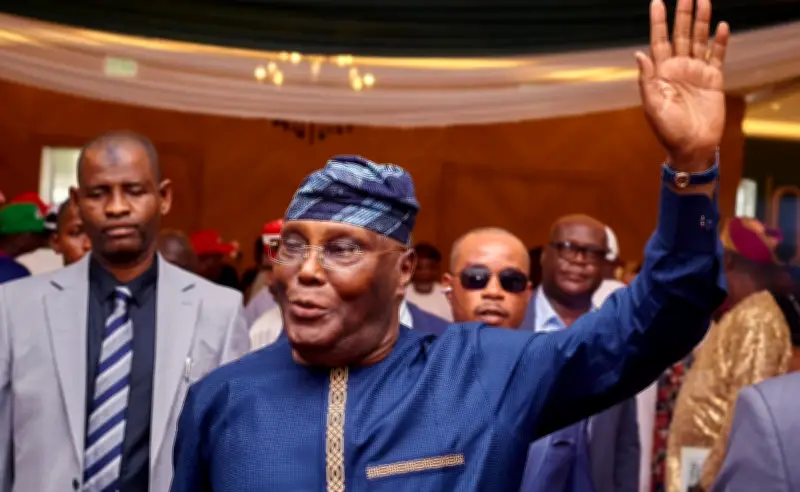
Former Vice President Atiku Abubakar has strongly denied allegations that he provided N5 million to the late Speaker of the House of Representatives, Ghali Na’Abba, to initiate impeachment proceedings against former President Olusegun Obasanjo during their first term in office. Atiku, who served as vice president under Obasanjo from 1999 to 2007, described the claim as a baseless political attack timed to damage his reputation ahead of the 2027 general elections.
Obasanjo’s Allegation and Atiku’s Response
The accusation was made by Obasanjo in a letter dated Thursday, responding to comments by former Ogun State Governor Olusegun Osoba about political developments before the 2003 elections. Obasanjo alleged that Atiku gave Na’Abba N5 million to commence impeachment proceedings and also attempted to persuade the late speaker to force Obasanjo to serve only one term. Atiku, now the presidential candidate of the African Democratic Congress (ADC), countered in a statement issued Friday by his Senior Special Assistant on Public Communication, Phrank Shaibu.
“If this allegation were true, why did he never make it while Rt. Hon. Na’Abba was alive? Why wait until the only man who could confirm or refute the claim has departed this world? By invoking a deceased man as the principal witness to such a grave allegation, former President Obasanjo has denied Nigerians the opportunity of hearing the other side of the story,” Atiku stated. He added that it is unfair to Na’Abba’s memory to use him in contemporary political battles when he can no longer defend himself.
Demand for Evidence and Timing
Atiku challenged Obasanjo to provide evidence to support the allegation, noting that if there was any criminal conduct, Nigerians should ask why no action was taken at the time by a government with full powers. “Coming at a time when the political landscape ahead of the 2027 general election is taking shape, the obvious objective is to besmirch my person and reputation and confer an undeserved political advantage on the former President’s kinsman. Nigerians, however, know better. They are too discerning to be distracted by stale allegations resurrected for political convenience,” he said.
The former vice president reiterated that his opposition to Obasanjo stemmed from resisting the unconstitutional third-term agenda. “My offence was that I stood firmly against the unconstitutional third-term agenda. As a democrat, I chose the path of constitutionalism and the rule of law. Rather than surrender democratic principles on the altar of personal ambition, I defended the Constitution and successfully asserted my rights through the courts in a series of landmark legal victories against a sitting President. Those battles are now part of Nigeria’s democratic history. It is evident that the bitterness arising from that defining period has failed to leave former President Obasanjo,” Atiku said.
Focus on Current Challenges
Atiku urged Obasanjo to openly endorse his preferred candidate for 2027 instead of making baseless allegations. He emphasized that Nigerians are more interested in solutions to pressing issues like soaring food prices, rising public debt, and scandals trailing the current administration than in revisiting political disagreements from over two decades ago. “The task before leaders today is not to rewrite history but to rescue the future,” he added.
Background: The 2002 Impeachment Move
The controversy dates back to 2002 when the House of Representatives, under Speaker Ghali Na’Abba, moved to impeach President Obasanjo. The lower chamber gave Obasanjo a two-week ultimatum to resign or face impeachment, citing failure to implement budgets and unauthorized military invasions of Odi in Bayelsa State and Zaki Ibiam in Benue State. The Senate later backed the move, but former heads of state Shehu Shagari and Yakubu Gowon intervened to halt the process. Na’Abba, who lost his re-election bid in 2003, believed Obasanjo worked against him. He died on December 27, 2023, at the age of 65.
Atiku’s statement underscores that he will not be drawn into prolonged exchanges over old disputes while Nigeria faces urgent economic and security challenges. He called for accountability and transparent leadership, urging Nigerians to focus on today’s problems rather than “recycled political tales from yesterday.”