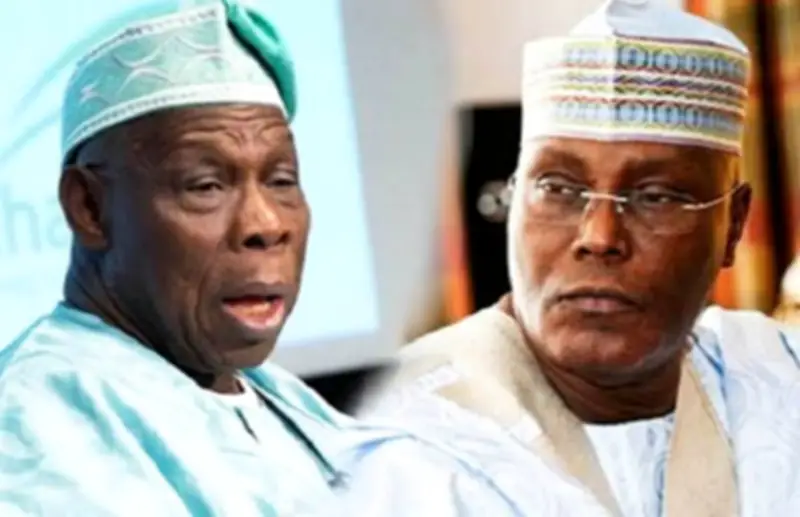
Former Vice President Atiku Abubakar has responded to former President Olusegun Obasanjo’s claim that picking him as running mate in the 1999 election was the biggest mistake of his presidency. In a statement issued on Saturday, August 1, 2026, Atiku said the remark was nothing more than “another failed attempt to rewrite history.”
Atiku’s response was delivered through his Senior Special Assistant on Public Communication, Phrank Shaibu. The former vice president insisted that Obasanjo’s bitterness is rooted in Atiku’s refusal to support the third-term agenda during Obasanjo’s time in office.
Obasanjo’s Claim Was ‘Another Failed Attempt to Rewrite History’
Obasanjo’s comment about the 1999 election is the latest in a series of critical statements directed at Atiku. But the former vice president was unequivocal in his rebuttal. He declared that he has no apology for opposing any attempt to subvert Nigeria’s democracy for personal ambition.
“I am proud that I stood against the third-term agenda. I am proud that I stood by the Constitution of the Federal Republic of Nigeria. I have no apology whatsoever for frustrating every attempt to subvert our democracy for personal ambition,” Atiku said.
A Badge of Honour
Atiku also tackled the former president’s apparent anger directly. He said that if Obasanjo’s resentment stems from Atiku’s decision to block an unconstitutional third term, then that resentment is a badge of honour. He added that no individual is bigger than the Federal Republic of Nigeria.
“If Chief Obasanjo’s bitterness stems from my refusal to support an unconstitutional third term, then I wear that resentment as a badge of honour. No individual, regardless of his status or accomplishments, is bigger than the Federal Republic of Nigeria. The Constitution is supreme, and I chose Nigeria over personal loyalty,” he said.
The Third-Term Battle and Its Legacy
The third-term agenda, which sought to extend the president’s tenure beyond the constitutional limit, was one of the most controversial political battles in Nigeria’s recent history. Atiku’s public opposition placed him at odds with his principal and set the stage for a permanent political break between the two.
In his statement, Atiku underscored that his fight was not personal, but a defence of democracy. He stressed that he stood firmly with the constitution and the will of the Nigerian people.
Observers have noted that Atiku’s stance during that period has become a key part of his political identity, and he continues to reference it as evidence of his commitment to democratic principles.
Atiku’s Support for Obasanjo in Prison Days
Atiku also took the opportunity to recall his past loyalty to Obasanjo, long before the political fallout. He said he stood by Obasanjo during his imprisonment, supported his family, worked for his release, and helped rebuild the former president’s political career.
According to Atiku, despite all that support and the years of friendship, the relationship collapsed because of political disagreements. Yet, Atiku said he has no regrets. He believes his decision to put the Nigerian constitution above personal loyalty was the right one.
This history of personal sacrifice adds another layer to the ongoing dispute. It suggests that Atiku’s opposition to the third-term agenda was not born out of malice or ambition, but out of a principled stance that tested a long-standing political alliance.
Implications for Nigerian Politics
The public exchange between two of Nigeria’s most consequential politicians reflects the deep and lasting divisions left by the third-term fight. It also serves as a reminder of the importance of constitutional limits in a young democracy.
Atiku’s statement clearly seeks to position him on the side of democratic values. By framing the issue in terms of constitutional supremacy, he is appealing to a broad audience of Nigerians who value rule of law over personality politics.
His response also signals that he is unwilling to let Obasanjo’s comments go unanswered. Even decades after the events in question, the two men remain at odds over the choices they made during a critical period of Nigeria’s political development.
It remains to be seen how Obasanjo will respond to Atiku’s latest remarks. For now, Atiku has drawn a clear line: he will not apologize for his role in blocking the third-term move, and he will continue to carry the former president’s resentment as proof of his commitment to the Nigerian constitution.