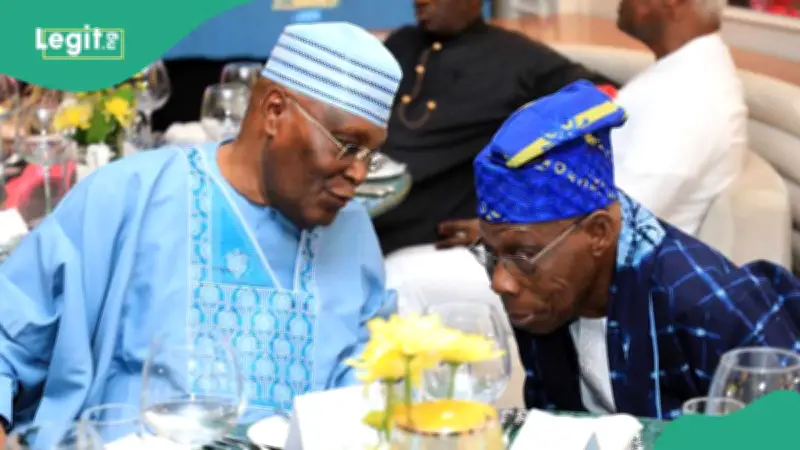
Former Vice President Atiku Abubakar has struck back at former President Olusegun Obasanjo's latest public attack, dismissing it as a bitter attempt to rewrite history. In a statement released on August 1, 2026, through his Senior Special Assistant on Public Communication, Phrank Shaibu, Atiku asserted that the former president's outburst cannot erase the record of what he did for Nigeria's democracy, nor the support he gave Obasanjo personally.
Atiku said he watched Obasanjo's interview with sadness rather than anger, describing the hostility as a long-standing grudge rooted in one defining moment: Atiku's refusal to back the third-term agenda. He was quoted as saying: "I am proud that I stood against the third-term agenda. I am proud that I stood by the Constitution of the Federal Republic of Nigeria. I have no apology whatsoever for frustrating every attempt to subvert our democracy for personal ambition."
Defending the Third-Term Opposition
The third-term controversy is one of the most contentious chapters in Nigeria's post-1999 political history. Obasanjo attempted to extend his tenure beyond the constitutionally guaranteed two-term limit, a move that collapsed after substantial resistance from lawmakers and key political figures. Atiku, who served as vice president from 1999 to 2007, became a leading opponent of the scheme, a decision that severely damaged his political relationship with his principal.
Atiku's response came barely 24 hours after World Trade Organisation Director-General Dr Ngozi Okonjo-Iweala publicly praised the economic management team he led as "the best Nigeria has ever had." The former vice president highlighted this timing, urging Nigerians to draw their own conclusions about why Obasanjo's criticism arrived on the heels of that endorsement.
He added that if Obasanjo's bitterness stems from his refusal to support what he saw as an unconstitutional extension of power, then he wears that resentment as a badge of honour. "I have no apology whatsoever for frustrating every attempt to subvert our democracy for personal ambition," he reiterated.
Atiku's Role in Obasanjo's Political Resurrection
Going beyond the third-term dispute, Atiku recounted the other side of history that he said Obasanjo consistently omits. He recalled that when Obasanjo was released from prison, he had little to his name. Atiku said he received him, provided for his needs and helped mobilise the political machinery that ultimately delivered the presidency to Obasanjo in 1999. That history, Atiku insisted, should not be replaced with revisionism or ingratitude.
The statement expressed disappointment that a former president would devote energy to recycling old grievances at a time when Nigeria is grappling with severe economic hardship, widespread insecurity and rising unemployment. Rather than attacking a former deputy, Atiku said, Obasanjo could have offered substantive solutions or constructive counsel to help address the nation's challenges.
Atiku's camp stressed that his years of restraint should not be misinterpreted as weakness. He remains firm in his conviction that history will judge him favourably. By pointing to the praise from Okonjo-Iweala, Atiku sought to reinforce the argument that his economic record stands on solid ground, and that Obasanjo's latest tirade reflects personal bitterness rather than objective assessment.
Political Rivalry Still Burns
The public clash between these two seasoned politicians underscores the deep fractures that persist within Nigeria's political elite. Obasanjo has long played the role of kingmaker, while Atiku has repeatedly sought the presidency. As the 2027 election cycle begins to take shape, this feud is unlikely to fade. But Atiku has made it clear that he will not be silenced or swayed by attacks from his former boss.
The timing of Obasanjo's interview, so soon after Okonjo-Iweala's favourable comment about Atiku's economic team, adds a layer of intrigue to the political drama. Nigerians are left to judge for themselves. Atiku, in his response, urged the public to see beyond the rhetoric and focus on the substance of his years in office.
As the dust settles, the exchange serves as a reminder that Nigeria's democratic journey has been marked by personal sacrifice and unresolved rivalries. Atiku's statement is not just a rebuttal; it is a statement of historical accounting. He insists that his decisions were guided by constitutional loyalty, not personal ambition, and he expects without apology to be judged by that standard.