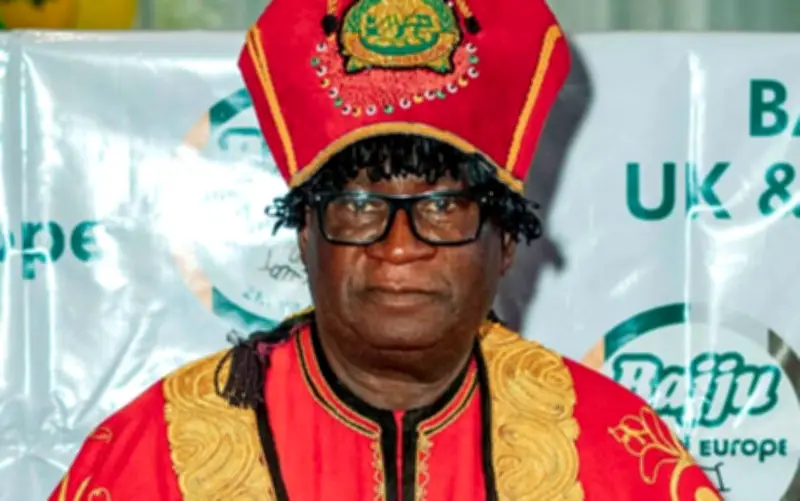
His Highness Luka Kogi Yabwat (Agwam Bajju II), the second paramount ruler of the Bajju Chiefdom, has said his reign is focused on completing a permanent palace, improving grassroots security, and deepening ties with the diaspora. In an exclusive interview with PREMIUM TIMES during his recent visit to the United Kingdom, the monarch detailed progress on these priorities, acknowledged the legacy of his predecessor, and outlined his vision for the next decade.
Palace Project and Government Support
Agwam Bajju II explained that when he assumed the throne in 2022, his immediate priority was securing a permanent residence for the king. He noted that the late king had secured land and laid a foundation for the palace, but had not completed a permanent structure because he lived in his own house. Building on that foundation, the monarch continued working with the committee appointed by the late king.
"When I came in, I had a lot of problems with accommodation," he said. "The late king was not able to secure a permanent palace because he was living in his own house, so he didn't put much effort into it. One good thing he did was secure the land and start something. The foundation was laid."
The monarch set a timeline for the committee to secure a temporary residence while work on the permanent palace progressed. He acknowledged that the timeline was extended, but said the project is now at an advanced stage. "Both our sons and daughters are contributing to its completion," he said. "We are trusting God that in the next one or two years, we will have a permanent residence, which is my heart's desire."
On government involvement, Agwam Bajju II stated that the Kaduna State Government has not provided any support for the palace project. "We have never received any support from the state government," he emphasised. "Even though we wrote to them about the project, we have not received any support to date. And I think it is not only the Bajju project. It is like that with most chiefdoms in the southern part of the state."
Diaspora Role and Educational Trust
The monarch expressed gratitude for the support of Bajju sons and daughters in the UK and Europe, who he said have contributed immensely to the palace project. During his visit, he witnessed the launch of the Bajju UK and Europe Association, which he described as a welcome development.
"They have been very strong supporters of the chiefdom down there," he said. "They have contributed immensely to the position we are now in regarding the progress of the palace project. We can say we are depending on them seriously."
The association has identified education as a priority and plans to establish an educational trust for less privileged children. Agwam Bajju II said the fund will have a significant impact, noting that "any society that is not developed educationally is a backward society." He added, "Their thought of establishing a fund for educational development is a welcome one. It will enable my people to rise. It will enable my people to meet the challenges of life."
Security and Local Structures
Security remains a major concern for the chiefdom, and the monarch highlighted the role of traditional institutions in supporting government efforts. He recounted a recent incident where local hunters rescued three kidnapped girls after receiving intelligence about armed strangers in a location unknown to the communities.
"They passed the intelligence report to us. We passed it to the government, the police, the DSS, and the rest — and we mobilised local security," he said. "When they attacked, we did not know that they had kidnapped three young girls and were hiding them in that location. But my own security, that is, the local hunters, were able to rescue them."
Agwam Bajju II noted that local people know the terrain, making them effective in such operations. "This has been the cry of everyone: that the federal government should work with local structures on security because local people know the terrain where the crisis is happening," he said. "I was here when I coordinated the whole activity. It was a huge success. The people are jubilating."
The monarch also described efforts to sustain peace with neighbouring communities through regular meetings with district, village, and ward heads, as well as security agencies. "Sometimes it is not through meetings. Sometimes they just call us and say something is happening somewhere, and then we organise," he explained. "I don't joke with any security issue. Any security report, I take action because I know what it used to be."
Investment, Youth, and Cultural Promotion
Agwam Bajju II called on diaspora investors to explore cottage industries and agricultural processing in Bajju land. He highlighted ginger and soybeans as crops currently exported in raw form that could benefit from local value addition.
"All kinds of cottage industries can come in," he said. "Even in agriculture, they can add value by processing some raw agricultural materials that are currently exported in raw form, especially ginger, soybeans, and others. If they can come in through such small industries to add value to agricultural products, I think that would attract more investment."
He also outlined programmes to shield young people from radicalisation, drug abuse, and crime, including committees formed to control alcohol and dangerous drugs. "We sat down and agreed to control alcohol and these dangerous drugs that the youth are indulging in," he said. "We formed committees. The district heads form committees that check those selling the drugs and those taking them. It has been a remarkable success in that area."
On cultural promotion, the monarch mentioned an annual festival organised by the Bajju Development Association that showcases traditional crafts. He noted that the land is fertile and rich in granite rocks, offering tourism potential, but security remains a key issue. "If we get security sorted, there is a lot of potential," he said.
Reflecting on his UK visit, Agwam Bajju II expressed pride in the unity he witnessed among Bajju people from Britain, France, the Netherlands, and Germany. "What I saw here is something that hasn't been done before," he said. "They showed us that even though they are far away, their hearts remain connected to the people back home."
Looking ahead, the monarch hopes to see continued progress in the next decade. "I hope to see much more than what I am seeing today because if they continue in this spirit, it is enough to change things back home," he said. He also encouraged the preservation of the Bajju language and culture among diaspora children, noting that "the Yorubas are good at maintaining their language and culture, and I encourage the Bajju people to do the same."