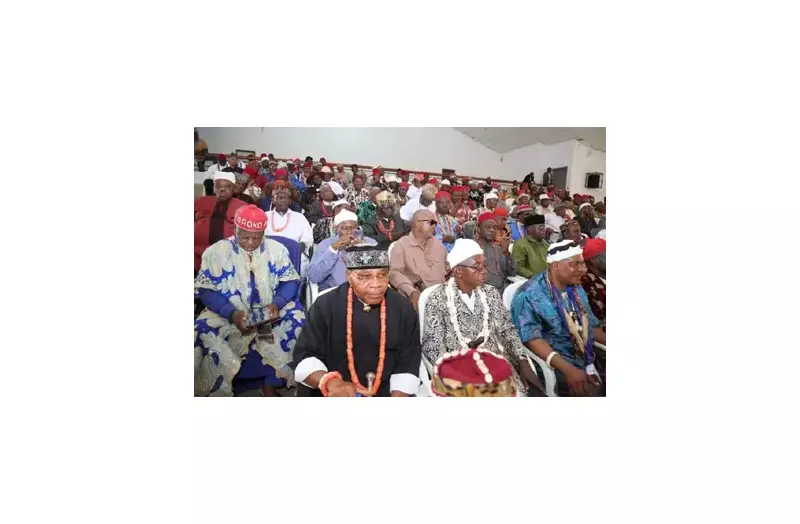
The intricate tapestry of Nigeria's political development is deeply interwoven with the influence of its traditional institutions. A historical assessment reveals how several prominent monarchs actively shaped the nation's regional structures and governance during its formative years, moving beyond ceremonial roles to become key political actors.
From Palace to Parliament: Monarchs in the Corridors of Power
The mid-20th century saw traditional rulers directly participating in the emerging political system. A prime example was Oba Uku Akpolokpolo Omo n'Oba n'Edo Akenzua II (1889-1978). Born in 1899 as Prince Edokparhogbuyunmun, he was the son of Oba Eweka II and grandson of the last independent King of Benin, Oba Ovonramwen.
After his education at Benin Government School and King's College, Lagos, his training for the throne included serving as confidential secretary to his father. Following his installation in 1933, Akenzua II became a central figure in national politics. Between 1946 and 1966, he served as a member of the Legislative Council of Nigeria, the Western House of Assembly, the Western House of Chiefs, and even as a Cabinet Minister.
His most significant political contribution was his instrumental role in the creation of the Midwest Region. He championed the unification of the Benin and Delta provinces, forming the Benin-Delta People's Party in October 1953 to campaign for this cause. With the region's creation, he became the first President of the Midwest House of Chiefs in 1964. His service was recognized with national honours, including the Commander of the Republic of Nigeria insignia, and he served as Chancellor of Ahmadu Bello University, Zaria, from 1966 to 1972.
Educated Monarchs and Diplomatic Legacies
The era also featured enlightened rulers who blended tradition with modern governance. Oba Rufus Adesokeji Aderele (Tewogboye II), the Osemawe of Ondo from 1942 to 1974, was noted for his education and administrative experience. His legacy extended into Nigeria's diplomatic corps through his son, Prince Ademola Olugbade Aderele, who served as an Ambassador and was Nigeria's first High Commissioner to Thailand.
Another exemplar was Oba Sikiru Olukayode Adetona, Ogbagba Agbotewole II, the Awujale of Ijebuland. Born on 10 May 1934, his appointment as king was confirmed by the Western Region Government on 4 January 1960. After a formal presentation on 18 January 1960 and a three-month traditional seclusion, his coronation was held on 2 April 1960. Just three days later, on 5 April 1960, he took his seat in the Western Region House of Chiefs, symbolizing the immediate political role of a newly installed monarch.
Thrones in Turmoil: Politics and Deposition
The political involvement of traditional rulers sometimes led to direct conflict with the government. The case of Ogiame Erejuwa II, the Olu of Warri, is particularly telling. Born Wilson Gbesimi Emiko in 1908, he reigned from 1951 to 1964 and again from 1966 to 1986.
His tenure was marked by political controversy. The title of his stool was a persistent issue, changing from "Olu of Warri" to "Olu of Itsekiri" in 1936 to pacify neighboring groups, before being reverted to its original form in 1952. As Olu, he was appointed a regional Minister without portfolio and President of the Warri Divisional Traditional Council.
However, his perceived alignment with the Action Group during the fierce rivalry leading to the creation of the Mid-West region had severe consequences. The NCNC-led regional government deposed him in 1964 and deported him to Ogbesse. He was only re-appointed in 1966 by the new military government under David Ejoor, after key political opponents had been removed from power.
This pattern of political engagement, from Oba Akenzua's legislative drive to Erejuwa's partisan struggles, underscores a period where the authority of the traditional stool was both a tool for regional development and a point of contention in Nigeria's volatile early politics. Their stories form a crucial, yet often underexplored, chapter in the nation's history.