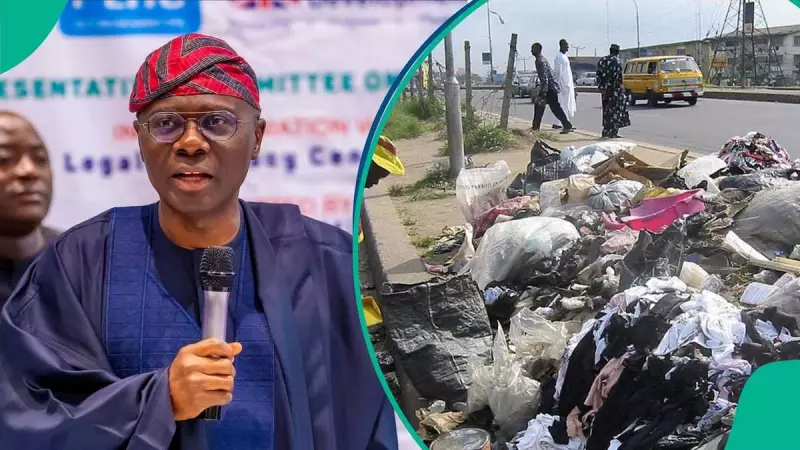
The Lagos State Government has declared its intention to reintroduce the monthly environmental sanitation exercise, a significant policy shift aimed at confronting the escalating waste management crisis in Nigeria's commercial capital.
Addressing a Mounting Waste Mountain
Dr. Muyiwa Gbadegesin, the Managing Director and CEO of the Lagos State Waste Management Agency (LAWMA), made the announcement during an engagement with journalists on Wednesday. He cited the overwhelming volume of waste generated in the megacity as the primary driver for this decision. Lagos, with over four million households, produces between 13,000 and 15,000 tonnes of waste every single day.
However, the current collection infrastructure is critically inadequate. Dr. Gbadegesin revealed that the existing Private Sector Partnership (PSP) operators manage to collect only 4,000 to 5,000 tonnes daily. This massive shortfall results in thousands of tonnes of refuse being dumped indiscriminately into drains, canals, lagoons, and the city's vital wetlands.
The LAWMA boss issued a stern warning about the environmental consequences, particularly the threat of flooding. He noted that wetlands constitute about 12% of Lagos's landmass, and indiscriminate dumping poses a severe risk to these sensitive ecosystems and the city's drainage systems.
Ambitious Plans for Infrastructure and Enforcement
To bridge the alarming collection gap, Dr. Gbadegesin outlined a multi-pronged strategy. He stated that for effective waste management, Lagos requires a fleet of at least 2,000 compactors. As an initial step, the state government plans to procure 500 mobile tricycle compactors in 2026 to enhance grassroots waste collection.
On enforcement, LAWMA has already taken action against underperforming service providers. Twenty-two PSP operators have been disengaged for poor performance, with their routes reassigned to more capable hands. The agency also pledged to collaborate closely with local government chairmen to regulate street trading and strengthen community-level waste management.
While the state is rolling out approximately 80,000 smart waste bins, Dr. Gbadegesin admitted this number is still insufficient for a city of Lagos's scale. He made a passionate appeal to residents to consistently pay their waste bills to enable PSP operators to improve their services.
Shifting to a Circular Economy: Waste as Wealth
A central pillar of Lagos's renewed waste management vision is a transition from a linear disposal model to a circular economy. Dr. Gbadegesin emphasized that nearly 90% of waste generated in Lagos has economic value if properly sorted and recycled.
He urged residents to actively support the state's waste-to-wealth initiatives, which aim to minimize landfill use by treating refuse as a resource. The LAWMA chief identified infrastructure deficits across the entire logistics chain—from collection bins to transportation and final processing—as the most significant hurdle to achieving this sustainable vision.
In a related development highlighting the state's focus on public-private partnerships, the Commissioner for Housing, Mr. Moruf Akinderu-Fatai, commissioned 233 units at the Abraham Adesanya Housing Estate. He called on private partners to maintain high standards and timely delivery, noting that the state has delivered about 11,000 housing units across various income brackets in the last six years.
The government's T.H.E.M.E.S+ Agenda continues to encourage private investment through incentives like land equity and tax rebates. However, a warning was issued that joint-venture projects failing to meet agreed timelines or standards face review and potential revocation.
LAWMA continues to encourage public vigilance, previously offering rewards for information leading to the apprehension of those dumping refuse illegally, underscoring the collective effort required to solve Lagos's sanitation challenges.