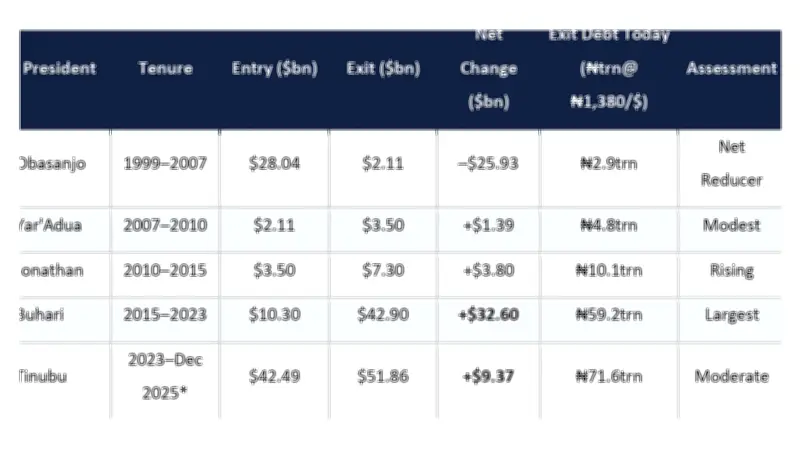
There has been public commentary portraying the current administration under President Bola Ahmed Tinubu as Nigeria's most aggressive borrower since the return to democracy in 1999, with some commentators claiming it has borrowed more than all previous democratic administrations combined. However, the available evidence does not support these conclusions.
External Debt Comparison
In May 2023, Nigeria's external debt stock stood at approximately $42.5 billion when President Tinubu assumed office, and by December 2025, it had risen to approximately $51.9 billion, representing a net increase of around $9.4 billion. By contrast, Nigeria's external debt increased from approximately $10.3 billion in 2015 to $42.9 billion by 2023, a net addition of about $32.6 billion during the Buhari administration. This evidence indicates that the largest increase in Nigeria's external debt stock in the democratic era occurred between 2015 and 2023, and President Tinubu is not Nigeria's largest borrower since 1999.
Exchange Rate Revaluation Effect
The claim of unprecedented borrowing under the current administration stems largely from the revaluation of inherited foreign-currency obligations following the June 2023 exchange-rate adjustment. Following exchange-rate unification, the naira depreciated significantly against the US dollar, which had a substantial accounting effect on the domestic valuation of Nigeria's external debt stock. The approximately $42.5 billion inherited by the current administration was valued at around ₦19.6 trillion under the previous exchange-rate regime. After revaluation at market exchange rates, the same stock appeared substantially larger in naira terms. This increase did not arise because the government borrowed tens of trillions of naira in new external obligations but reflects the massive effect of applying a weaker exchange rate to an existing stock of foreign-currency debt.
Domestic Debt Trends
In dollar terms, domestic debt eased from about $65.6 billion in Q1 2023 (Buhari era) to $59.1 billion by end-2025 (Tinubu era), a decline of roughly $6.5 billion. That sits against an increase of around $11.6 billion during the Buhari years. When adding domestic and external debt together, total public debt rose by only about $2.7 billion in dollar terms between Q1 2023 and Q4 2025, even though the naira headline rose by roughly ₦109.4 trillion over the same period. Both figures are correct, but only the dollar measure reflects actual new borrowing.
Accounting Adjustments
Between Q1 and Q2 2023, the naira value of external debt rose from ₦19.6 trillion (Buhari) to ₦33.2 trillion (Tinubu) with little change in dollar terms, reflecting exchange rate unification and revaluation of existing debt. In the same period, domestic debt increased from ₦30.2 trillion (Buhari) to ₦54.1 trillion (Tinubu), driven primarily by the securitisation and balance sheet recognition of ₦23.9 trillion in Ways and Means advances; these were previous Central Bank overdrafts accumulated under Buhari and subsequently converted into marketable government debt instruments. These movements represent accounting reclassification and stock revaluation adjustments, not incremental fiscal borrowing flows.
Conclusion
A fact-based assessment of Nigeria's debt profile leads to one clear conclusion: the central challenge facing Nigeria today is not merely how much has been borrowed, but how inherited obligations, debt-service pressures, and limited revenues constrain the country's development ambitions. Debt service absorbs a substantial proportion of government revenues, continuing to constrain fiscal space for infrastructure, healthcare, education, security, and other critical expenditures.