Obasanjo Spills on His Biggest Political Mistake
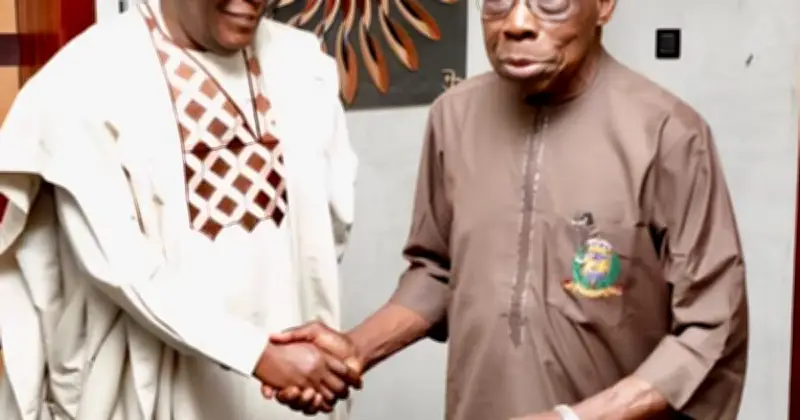
Former President Olusegun Obasanjo has publicly described his decision to pick Atiku Abubakar as his vice-presidential running mate in 1999 as the biggest mistake of his political career. He made the revelation during a sit-down interview with Arise News, where he also thanked God for what he called divine protection that stopped Atiku from harming Nigeria or derailing his administration.
Obasanjo, who served as Nigeria's president from 1999 to 2007, was asked to reflect on his time in power. He startled the interviewer by declaring that the choice of his second-in-command was the most regrettable decision he ever made. But he initially did not utter Atiku's name, referring to him only as "the man I picked as my running mate and number two." When the interviewer directly asked if he meant Atiku Abubakar, Obasanjo confirmed without hesitation: "My vice president. I don't know what name you want to give him, but my vice president. And I mean that."
He went further, indicating that Atiku's conduct during their eight years in office could have had catastrophic consequences. "What I knew about him later makes me thank God, because God did not allow his actions and reactions to overwhelm me, or to divert my focus from Nigeria, or to harm Nigeria," Obasanjo said. He insisted that he does not harbor personal bitterness toward his former deputy, attributing the entire experience to a higher power. "There is no bitterness because, well, he did things that he believed he should do, and God did things that God had to do, which made me able to achieve what I was able to achieve."
The Rise and Fall of a Political Ticket
Obasanjo and Atiku were elected together in 1999 under the banner of the People's Democratic Party (PDP), marking the end of decades of military rule and the dawn of Nigeria's Fourth Republic. Their ticket won re-election in 2003, and they served two consecutive terms, a total of eight years, until 2007.
The partnership, however, began to fray during the second term against the backdrop of Obasanjo's alleged third-term agenda. Atiku publicly opposed attempts to extend the president's tenure, a stance that created an irreparable rift between the two men. The crisis reached a tipping point when Atiku left the PDP ahead of the 2007 elections, after which they became open political adversaries rather than allies.
The interview, broadcast on Arise News on July 31, 2026, quickly circulated on social media. The channel posted a short clip on X, formerly known as Twitter, captioned with Obasanjo's quote: "The choice of Atiku as my running mate as civilian president was a mistake — OBJ." In the video, Obasanjo is heard saying, "If I had known him as I came to know him later, I would not have picked him."
Previous Admissions and Political Fallout
This latest admission is not an isolated incident. Obasanjo had previously expressed regret in 2022, telling students at a SAGE event in Abeokuta that selecting his number two was one of the genuine mistakes of his public life. At that time, he added that God had saved him from the consequences of that decision, although his remarks were not as pointed as this recent interview.
The former president's comments carry significant weight in Nigeria's political landscape, where both Obasanjo and Atiku have remained influential figures. Atiku, who has been the PDP's flagbearer in multiple presidential elections, including the controversial 2019 poll, has yet to respond to the latest accusation. As of the time of this report, his camp has remained silent, possibly reflecting the sensitivity of the matter.
Obasanjo's declaration could further complicate an already fraught political relationship. While he stressed that he is free of bitterness, the severity of his language suggests that the old wounds from their time in office have not fully healed. The former president's assertion that Atiku's actions could have "harmed Nigeria" is among the strongest accusations he has leveled against his erstwhile running mate.
Political analysts might note that Obasanjo's willingness to revisit the past underscores the lasting impact of the third-term controversy, which remains a defining episode in Nigeria's democratic history. The episode not only shattered their partnership but also altered the trajectory of the PDP, eventually leading to internal party crises in subsequent years.
For now, the Nigerian public is left to ponder the implications of Obasanjo's words. With an election cycle periodically igniting old rivalries, such a high-profile admission may well influence public perception of both men. Whether Atiku breaks his silence or chooses to let the remarks slide remains to be seen, but the statement has already reignited discussions about one of Nigeria's most consequential political pairings.