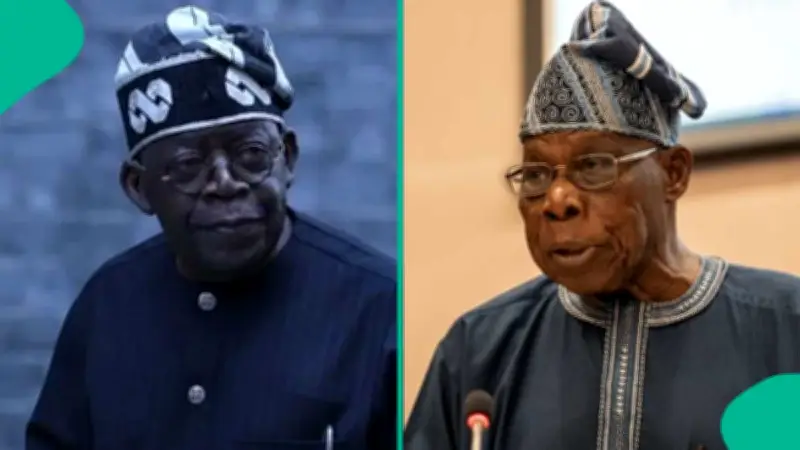
Former President Olusegun Obasanjo has openly criticised President Bola Tinubu's economic policies, arguing that currency devaluation and related reforms have driven millions of Nigerians deeper into poverty. Speaking at the Financial Times Africa Summit 2026 in London on Wednesday, October 21, Obasanjo addressed the consequences of the Tinubu administration's foreign exchange and subsidy decisions.
Obasanjo's Criticism of Naira Devaluation
Obasanjo focused particularly on the naira's collapse, saying Nigeria's standing as the country with the largest number of poor people in the world is a direct result of the devaluation, as reported by Daily Trust. He highlighted the scale of the currency's fall, stating: "We do not live in isolation as a country. We interact with the rest of the world. And overnight, you devalue the currency by 300 percent. The naira went from N500 to a dollar to N1,500 to a dollar."
He further explained the impact on ordinary Nigerians: "What that meant was that every Nigerian is made poor by 300 percent. That made Nigeria become the poverty capital of the world, which means Nigeria has the largest number of poor people in the world. You cannot say to me that that is good for Nigeria. You cannot say to me that that is good for us in any sense."
Tinubu's Reforms and Their Impact
The policies Obasanjo referenced began shortly after Tinubu took office. In May 2023, the president announced the removal of the petrol subsidy, a move that immediately pushed up fuel prices and raised transport costs across the country. The following month, the administration launched foreign exchange reforms that allowed the naira to trade more freely, effectively ending the multiple exchange-rate system that had been in place for years.
The government said the changes were designed to attract foreign investment, improve market efficiency and remove distortions in the currency market. In practice, however, the reforms coincided with a steep fall in the naira's value, a surge in inflation and a significant rise in the cost of imported goods. Food prices, transport fares and the cost of basic necessities all climbed sharply, squeezing household budgets and eroding the purchasing power of businesses and ordinary citizens alike.
Yoruba Claims Obasanjo Is Backing Tinubu for 2027 Elections
Legit.ng notes that Obasanjo's statement may have contradicted the claim by the Yoruba Ronu Leadership Forum that the former president was working behind the scenes to secure a second term for President Bola Tinubu ahead of the 2027 general elections. In a statement dated Sunday, July 26, and signed by the forum's president, Chief Akin Malaolu, the Lagos-based group argued that Obasanjo's recent letter to former Ogun State Governor, Chief Segun Osoba, was not a personal attack on former Vice President Atiku Abubakar but a calculated move against the Nigerian opposition.
In the letter, Obasanjo alleged that Atiku had mobilised the late former Speaker of the House of Representatives, Ghali Umar Na'Abba, to initiate impeachment moves against him while he was president. Atiku has since responded, accusing Obasanjo of continuing to harbour grievances over his role in frustrating what the former vice president described as the former president's "ignoble Third Term agenda."