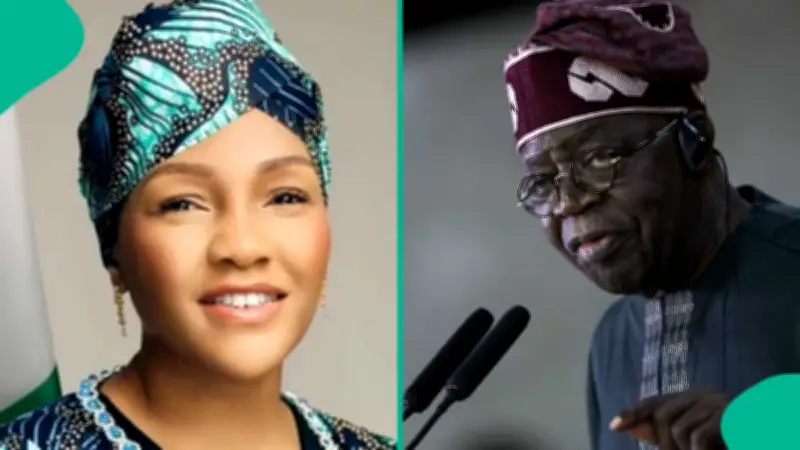
Princess Zahrah Mustapha Audu, Director-General of the Presidential Enabling Business Environment Council (PEBEC), has called for President Bola Tinubu to be assessed in the same historical context as former South African President Nelson Mandela and Ghana's late leader Jerry John Rawlings. In a published article, Audu argued that significant political figures should be judged across the full span of their careers, not through any single contested episode.
Audu, who also serves as National Publicity Secretary of the City Boy Movement, examined Tinubu's political trajectory, the controversies surrounding his biography, and the economic decisions his administration has taken since 2023. She acknowledged that Tinubu's economic reforms have imposed real hardship on Nigerians, including rising inflation, worsening food insecurity, and increased cost of living, while referencing International Monetary Fund (IMF) assessments that recognised the structural importance of the reforms.
Why Audu invoked Mandela and Rawlings
Audu pointed to Mandela's journey from political prisoner to South Africa's first Black president, and to Rawlings' career, which moved between military rule and elected constitutional government in Ghana, as examples of how complex political legacies take shape over time. She was careful to note that Tinubu's circumstances differ from those of both men and that the comparison was not meant to suggest equivalence.
"History rarely evaluates consequential political figures from a single chapter of their lives," she wrote.
On the ongoing questions about Tinubu's educational background, Audu said Nigerians had every right to scrutinise their president's biography but urged that allegations, disputed facts and verified facts be kept clearly separate. She referenced the 2023 court proceedings involving Chicago State University, during which the institution's registrar confirmed that Tinubu attended the university and graduated in 1979, while noting that a separate dispute existed over the origin and authenticity of a diploma copy submitted to Nigerian electoral authorities.
"His certificates may be questioned. His biography may be contested. But his political accomplishments cannot simply be written out of history," she said.
Tinubu's record and economic reforms
Audu traced Tinubu's political career from his time in the Senate during the aborted Third Republic, through two terms as Lagos State governor from 1999, his role in building opposition coalitions, the formation of the All Progressives Congress, and his emergence as Nigeria's president. She described this as decades of sustained political organisation and negotiation.
On economic policy, she highlighted the removal of the petrol subsidy and the overhaul of the foreign-exchange regime as consequential decisions, while acknowledging they had driven up inflation, worsened food insecurity, and pushed up the cost of living for ordinary Nigerians. She referenced IMF assessments that recognised the structural importance of the reforms while also raising concerns about poverty and social protection.
Audu urges balanced assessment of Tinubu's legacy
Audu urged both Tinubu's supporters and critics to resist what she called hagiography and reductionism, insisting that controversies should not be dismissed by admirers nor used by critics to wipe out a political record entirely. She called for a broader assessment of Tinubu's political career, arguing that his accomplishments should not be overshadowed by disputed episodes.
"History is not acquittal, history is accumulation," she wrote, adding that she considered Tinubu to be Nigeria's greatest president to date. The article, published ahead of the 2027 elections, sets the stage for ongoing debates about Tinubu's legacy and the impact of his administration's policies on Nigerians.