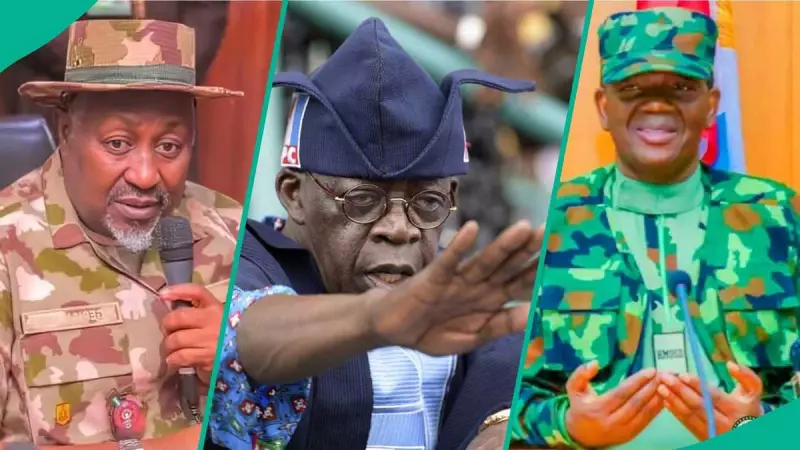
Fresh details have surfaced regarding the sudden departure of former Minister of Defence, Badaru Abubakar, revealing that a deep-seated and protracted conflict with the Minister of State for Defence, Bello Matawalle, was the primary catalyst for his exit.
The Public Health Reason Versus The Private War
Badaru officially resigned from his position on Monday, December 1, 2025, after serving for approximately two years. The Presidency, through the Special Adviser on Information and Strategy, Bayo Onanuga, initially presented his departure as being motivated by "poor health." This narrative was swiftly followed by President Bola Tinubu swearing in the former Chief of Defence Staff, General Christopher Musa (retd.), as the new substantive Minister of Defence.
However, investigations indicate that the resignation was the culmination of months of strained relations between Badaru and Matawalle, a silent rivalry carefully concealed from public view but which significantly hampered the ministry's effectiveness.
Inside the Fractured Defence Ministry
According to senior military sources, the working relationship between the two top defence officials was "frosty" for most of Badaru's tenure, which began on August 21, 2023. Publicly, they maintained a cordial facade, but internally, their discord was an open secret.
"Pairing the two together as ministers is something that ought not to have happened in the first place," one official disclosed, highlighting how the tension disrupted coordination in areas ranging from media management to operational harmony.
The rift was reportedly exacerbated by Matawalle's growing political influence within the ruling All Progressives Congress (APC), particularly in the North West, where he is seen as a strategic asset for the 2027 political calculations. In contrast, Badaru was perceived as having weaker political standing, which diminished his leverage within the presidency.
Mounting Security Pressure and International Scrutiny
Badaru, a former governor of Jigawa State, was appointed with high expectations to tackle the escalating insecurity, especially banditry in the North West. However, his leadership came under intense scrutiny due to:
- Renewed bandit attacks and mass school abductions.
- Rising public criticism and pressure following President Tinubu's declaration of a nationwide security emergency.
- International condemnation, including the United States redesignating Nigeria as a "Country of Particular Concern" over allegations of mass killings of Christians.
This combination of external security crises and internal ministerial friction created an untenable situation, leading to Badaru's decision to resign.
Fallout and the Path Forward Under General Musa
Following Badaru's exit, calls from civil society groups and political commentators for Matawalle's removal have grown louder. These were fueled earlier by allegations from Zamfara State Governor Dauda Lawal linking Matawalle to bandit groups—claims the minister has repeatedly denied.
Despite the pressure, sources suggest Matawalle may retain his position as part of a broader security strategy, evidenced by his recent deployment to Kebbi State following a student abduction. Notably, he was absent when the new minister, General Christopher Musa, formally assumed duty on Friday.
In his first address, General Musa outlined a sweeping reform agenda, declaring that "Nigeria can no longer afford disjointed operations." His immediate priorities include:
- A comprehensive review of theatre commands and inter-service structures.
- Treating personnel welfare as a strategic priority, ensuring timely payment of allowances and proper kits.
- Enforcing zero tolerance for corruption and indiscipline.
- Deploying technology and intelligence-driven planning to strengthen security partnerships.
General Musa's confirmation by the Senate on Wednesday, December 3, after a five-hour grilling, marks a new chapter for the defence ministry, which must now navigate the aftermath of internal strife while confronting Nigeria's persistent security challenges.