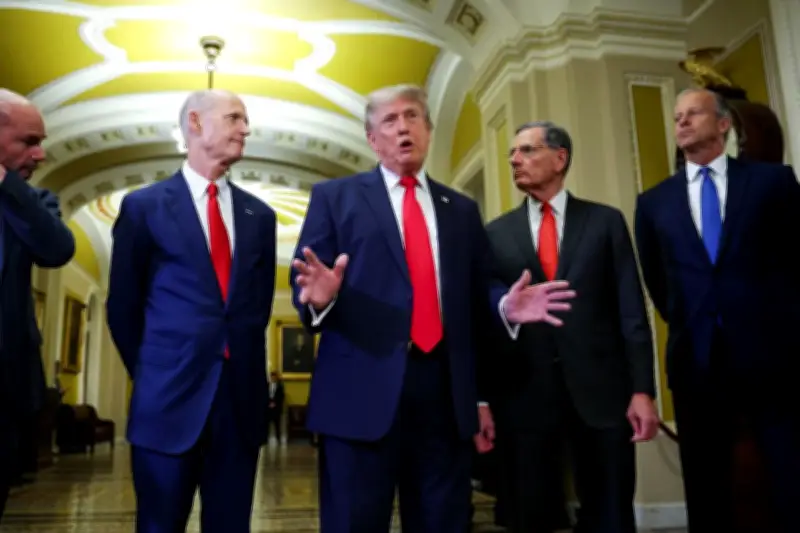
The United States Senate on Wednesday walked back its rebuke of President Donald Trump's handling of the conflict with Iran, rejecting a war powers resolution just one day after adopting a similar measure aimed at removing US military forces from the conflict. The late-night vote, which ended in a 47-50-1 tally, came after Trump expressed frustration with Senate Republicans who had supported the earlier resolution, arguing that Congress had undermined his negotiating position with Iran.
Key Republicans switch votes
Republican Senators Rand Paul of Kentucky and Bill Cassidy of Louisiana, who had previously voted to rein in the president's war powers on Iran, changed their votes. Paul voted present, while Cassidy voted against advancing the resolution. Republican Senators Susan Collins of Maine and Lisa Murkowski of Alaska once again voted for the resolution, while Democratic Senator John Fetterman of Pennsylvania again voted against it. Trump welcomed the vote on Truth Social, noting Paul's and Cassidy's shifts and writing, “This vote puts Iran on notice!”
Cassidy confronts Trump at Senate lunch
Earlier Wednesday at a tense Senate GOP lunch with Trump, Cassidy went toe-to-toe with the president on Iran, telling him he would continue voting for war powers measures until Congress and the American people are given more information on the conflict. “I stood and said, ‘You have not told the American people what’s going on. It was supposed to last four weeks, it’s lasted four months. Our original objectives have not been achieved, and I want to know what’s going on,’” Cassidy told reporters after the meeting. However, later Wednesday, the Louisiana Republican said he had received a “thorough briefing” from Vice President JD Vance and special envoy Steve Witkoff on Iran. “I want to thank Vice President Vance and Special Envoy Witkoff for the thorough briefing this afternoon on Iran. I appreciate the quick invitation to the White House to address many of my concerns,” he posted on X.
Paul explains his vote
Paul wrote on X Wednesday that his opinion on the war had not changed but that Trump “asked me to give consideration to his negotiating position.” “My opinion on the debate over war and executive power has not changed and I have voted that way several times. But since hostilities seem to be over and the President asked me to give consideration to his negotiating position, I will do so. My vote of present is a way to give the President more space and leverage to negotiate a lasting peace,” he wrote.
Trump criticizes absent Republicans
During the Capitol Hill meeting, Trump also criticized GOP Senators Dave McCormick of Pennsylvania and Mitch McConnell of Kentucky for missing Tuesday’s vote. However, McConnell remains hospitalized, and McCormick was on Air Force One with the president en route to an event in Pennsylvania during the vote. Wednesday’s vote marks the 11th time the Senate has voted on an Iran war powers measure since the beginning of the year. This resolution was discharged from committee in a floor vote last month, in another case of GOP absences, but Democrats wanted to wait to push for a follow-up vote to ensure they had the support to pass it. Republicans brought it to the floor Wednesday night, hopeful that they could defeat the measure.
Trump's previous attacks on GOP defectors
Trump has laid into Republicans who have backed various Iran war powers resolutions. After the House adopted a concurrent resolution 215 to 208 earlier this month, with four House Republicans voting with Democrats, Trump called the Republicans “GRANDSTANDERS” and their action “unpatriotic” in a post on Truth Social. After the Senate also adopted the concurrent resolution on Tuesday, 50-48, Trump called the four Senate Republicans who backed it “losers,” adding, “These Senators have just made my job more difficult.”
Democratic perspective
Some Democratic senators, including Tim Kaine of Virginia, have argued that passage of a war powers resolution is necessary, even after the US reached a preliminary agreement with Iran. “I think it’s a good time to have the vote to say, ‘Hey, if we’re really in a period of maybe some stability here, let’s not just allow it to start up again without Congress being involved in that decision,’” he told reporters last week.