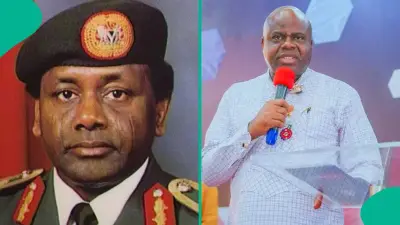
Managing Director of the Federal Housing Authority (FHA) and Convener of the South West Agenda for Asiwaju (SWAGA), Hon. Oyetunde Ojo, has declared that President Bola Tinubu deserves re-election in 2027, citing ongoing reforms in infrastructure, education, power, and security as evidence of an administration laying the groundwork for long-term national development.
Ojo also renewed his advocacy for the establishment of state police, insisting that Nigeria’s worsening security challenges underscore the urgency of decentralising policing and strengthening local security architecture.
Speaking during a live media interview aired on four national television stations on Monday, the former member of the House of Representatives argued that many of the problems confronting Nigeria predated the Tinubu administration and required difficult but necessary reforms to resolve.
According to him, the President inherited deep-rooted structural challenges that accumulated over several decades but has shown the political courage to embark on reforms previous administrations either avoided or postponed.
“President Tinubu met longstanding problems in virtually every sector. What he has done is to begin addressing them frontally and laying a foundation that future generations will benefit from,” Ojo said.
Renewed Call for State Police
On security, the FHA boss maintained that Nigeria would have been better positioned to confront emerging threats had state police been adopted years ago. He recalled that while serving in the National Assembly between 2011 and 2015, he supported efforts to introduce state policing during the administration of former President Goodluck Jonathan but said the proposal was resisted largely for political reasons.
“We saw the warning signs early. The instability spreading across the Sahel and the collapse of security structures in neighbouring countries demanded a different approach. Unfortunately, politics prevailed over national interest,” he said.
Ojo noted that Tinubu had consistently championed state policing long before becoming President, drawing lessons from countries where local policing complements federal law enforcement structures. He cited Lagos State’s security model under Tinubu’s governorship, including the Rapid Response Squad (RRS) and the Lagos State Security Trust Fund, as examples of how local initiatives can strengthen security outcomes.
“The reality we face today only reinforces the need for state police. The National Assembly should conclude work on the constitutional amendments, while states should prepare to assume greater responsibility for securing their territories,” he added.
While acknowledging current security concerns across parts of the country, Ojo advocated increased deployment of technology, intelligence gathering, and aerial surveillance to strengthen border security and combat criminal activities. He also called on local innovators and technology firms to support national security efforts through the development of indigenous drone and surveillance technologies.
Infrastructure and Economic Reforms
Assessing the administration’s performance, Ojo pointed to ongoing infrastructure projects across the country as visible evidence of government’s commitment to economic renewal. He highlighted major road projects, including the Abuja-Makurdi-Otukpo-Enugu highway, the Kaduna-Kano corridor, the Lagos-Ibadan Expressway, and other strategic routes connecting different parts of the country.
According to him, many of the projects are being executed with reinforced concrete technology designed to improve durability and reduce future maintenance costs.
“These projects are transformational. They are opening up economic corridors, improving connectivity, and creating the infrastructure base required for sustained growth,” he said.
Ojo also cited stability within the tertiary education sector as one of the administration’s notable achievements, observing that public universities have remained largely open without the prolonged industrial actions that disrupted academic calendars in previous years. He attributed the development to sustained engagement between government and academic unions, which has helped preserve stability within the university system.
“For the first time in many years, students are progressing through their programmes without the uncertainty that came with repeated nationwide strikes,” he said.
The former lawmaker further argued that recent assessments by international financial institutions and rating agencies reflected growing confidence in Nigeria’s economic direction. While acknowledging the hardships associated with some policy adjustments, he maintained that the reforms were necessary to restore fiscal discipline, attract investment, and place the economy on a sustainable path.
Power Sector Reforms
On power sector reforms, Ojo described the Electricity Act as a landmark policy that has expanded opportunities for states and private investors to participate in electricity generation and distribution. He said the legislation dismantled longstanding restrictions that hindered sub-national governments from independently pursuing power projects, creating new possibilities for improved electricity supply.
“Power sector reform is a long-term process. What the administration has done is to create the legal and policy framework that will unlock investment and competition across the sector,” he said.
Ojo stressed that many of the administration’s reforms were designed to tackle structural deficiencies that had accumulated over decades and would require patience to deliver their full benefits. He urged Nigerians to support the continuation of the Tinubu administration beyond 2027, arguing that the reforms currently underway would yield greater dividends as they mature.
“Nigerians should judge this administration not only by present challenges but also by the direction of travel. The foundations are being laid, and the benefits will become increasingly evident in the years ahead,” he said.